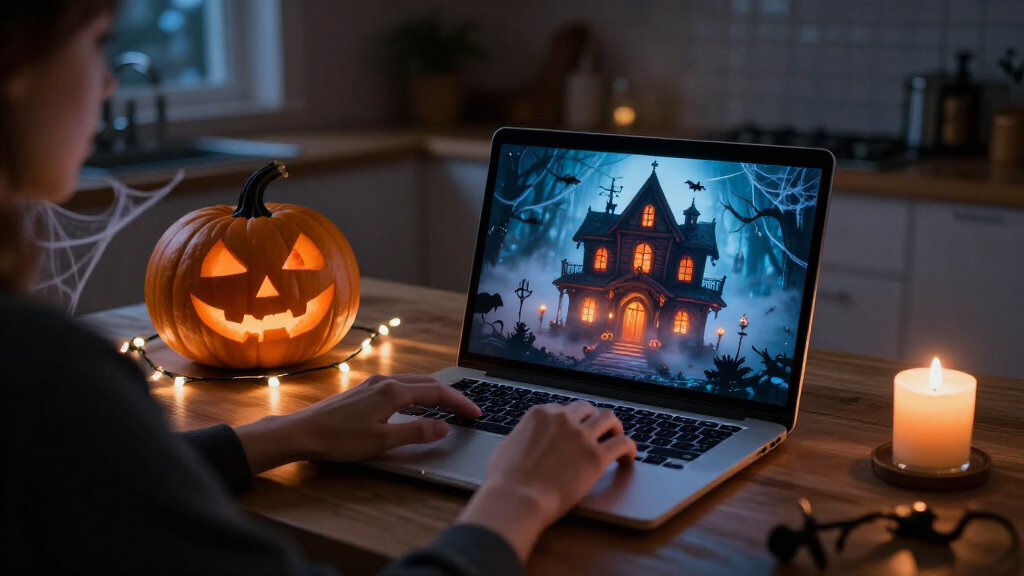

🔍 Read the full analysis: How AI Can Help You Picture A Haunted Halloween Home on ThorstenMeyerAI.com

Get business pricing on monitors, keyboards and dev gear
- Business-only prices and quantity discounts
- Tax-exempt purchasing
- Multiple users, one account, clear invoices
TL;DR
AI tools can now create custom haunted visuals, voices, and responsive character dialogue for Halloween displays. However, many products marketed as AI-powered rely only on motion sensors and prerecorded audio, so buyers should verify what a device actually does before purchasing.
A new consumer guide from ThorstenMeyerAI.com explains how households can use artificial intelligence to build custom Halloween displays — generated haunted portraits, talking characters, and coordinated light-and-sound scenes — while warning that many decorations marketed as “AI-powered” are in fact ordinary motion-sensor props with prerecorded audio. The guide arrives as shoppers face a growing shelf of “smart” spooky products and offers a framework for judging what those products actually do, what they cost in setup and privacy, and whether the added complexity is worth it.
The central distinction the guide draws is between automation and genuine AI capability. A prop that plays the same shriek every time someone walks past is sensor-triggered automation — effective, but identical on every trigger. A product using actual AI may generate new content, recognize speech, or adapt a character’s response to input. “A motion sensor that triggers a prerecorded shriek can still make an excellent scare, but by itself it is ordinary automation,” the guide notes. The difference matters after the first trigger: a recording repeats the same way, while an AI feature may interpret input or create different content — an effect that feels more personal but is less predictable and requires more setup.
The guide breaks AI decor features into separate capabilities, each with its own tradeoffs. Generative AI can create a haunted portrait or draft a witch’s dialogue. Voice recognition lets a prop respond to spoken phrases. Computer vision can analyze camera images, though the guide flags that image analysis raises privacy concerns. A porch gargoyle that plays the same growl is sensor-triggered; one that answers a visitor’s question with a speech system adds another layer — and another cost, since speech recognition can fail in noisy outdoor settings and generated content needs human review.
For practical planning, the guide recommends a four-step build: pick one clear moment for the visitor, create the content with image or audio tools, choose a trigger and output method, and test the scene from the visitor’s point of view. It also advises checking whether each feature runs locally or through an online service. Local playback offers less variation but tends to be faster and more dependable; cloud-dependent features can adapt and generate more but can stall when Wi-Fi drops — a risk the guide illustrates with a smart bulb that fails to shift color at the exact moment guests reach the door.
A motion-triggered recording is automation; AI usually means a system generates or interprets content.
Use generated art, voices, or dialogue to personalize a scene, then review the results and usage terms.
Plan one clear visitor moment before choosing sensors, lights, speakers, or controllers.
Test offline behavior, sensor timing, audio, cable placement, and outdoor protection before Halloween night.
Tell visitors when a display processes faces or voices, limit collection, and provide a way to pass without interacting.
Why the ‘AI-Powered’ Label Deserves Scrutiny
Marketing language on Halloween decorations does not always spell out which features a device actually uses, and the guide’s core warning is that the “AI-powered” label is frequently overstated. For shoppers, the practical stakes are money and expectations: paying for complexity guests will barely notice, or expecting adaptive behavior from what is actually a looped recording. The guide urges buyers to check current availability, capabilities, pricing, and privacy settings before purchasing.
The distinction also affects reliability and privacy. A display that depends on an online service transmits data outside the home and can fail mid-evening; a local fallback — a recording or simple light cue — can preserve a scene when the more flexible feature breaks. For households hosting a crowded Halloween evening, the guide argues a simple local trigger can prove more dependable than a cloud feature.
From Jump Scares to Generated Characters
Traditional animated Halloween props have long relied on motion sensors, pressure pads, and prerecorded audio. Recent advances in consumer AI tools — image generation, voice synthesis, and speech recognition — have expanded what hobbyists and manufacturers can build, from custom-generated haunted portraits to characters that hold short porch conversations with visitors.
The guide positions this as a spectrum rather than a binary: motion-triggered props suit a simple jump scare; generated media suits themed backdrops; responsive characters suit brief interactions; and connected effects coordinate lights, speakers, and plugs across a room. It also notes that elaborate builds may call for hobby electronics, coding, and extra troubleshooting, while a modest display needs only a smart light, a speaker, and a trigger.
“A motion sensor that triggers a prerecorded shriek can still make an excellent scare, but by itself it is ordinary automation.”
— ThorstenMeyerAI.com guide
What the Guide Leaves Open
The guide does not name or rate specific commercial products, so readers must verify individual devices themselves. Product details, availability, and pricing can change, particularly during the seasonal shopping rush.
Several practical questions also remain dependent on the individual product: whether a device’s AI features work offline, what data is sent to online services, what licenses apply to generated voices and visuals (some may limit commercial use or sharing), and how speech recognition performs in noisy outdoor environments. The guide notes that generated content can need cleanup and may sound out of character or be inappropriate for an audience even when technically polished — outcomes that only testing can reveal.
Planning a Display Before October 31
For readers planning an AI-assisted display, the guide’s recommended sequence is to start small and test early: build one scene, rehearse it from the visitor’s perspective, and add devices only when each one improves the moment enough to justify its setup and failure points. Buyers should confirm before purchasing whether a product’s AI features run locally or in the cloud, and what privacy settings are available.
As consumer AI tools continue to spread into seasonal products, sharper labeling standards or third-party reviews distinguishing real AI from marketing may follow; for now, the guide places the burden of verification on the shopper.
Key Questions
How can I tell if a Halloween decoration actually uses AI?
Check whether the product generates content, recognizes speech, or adapts its responses to input — or simply plays a fixed recording when triggered. A prop that repeats the same sound or motion every time is sensor-triggered automation, not AI. Product listings do not always make this clear, so review the feature list and privacy settings before buying.
Do I need an internet connection for AI Halloween decor?
It depends on the product. Features that run locally are usually faster and more dependable but offer less variation; cloud-based tools can generate or adapt more content but stop working if Wi-Fi drops and may send data to an online service. The guide recommends keeping a local fallback, such as a recording or simple light cue.
What is the easiest way to add AI to a Halloween display?
The guide suggests starting with one scene: a single clear cue, such as a portrait that whispers a short welcome, supported by a smart light, speaker, and trigger. Use an image or audio tool to draft the content, edit it, and test it from the visitor’s point of view before adding anything else.
Are there privacy concerns with AI decorations?
Yes. Computer vision features analyze camera images, and online-dependent features can transmit data outside the home. Buyers should check whether a device processes data locally or sends it to a service, and review the available privacy settings.
Is a more complex display always better?
No. The guide argues that one striking, well-timed moment often lands better than many competing sounds and lights, because visitors need time to register each cue. More effects also mean more delays, conflicting triggers, and troubleshooting.
Source: ThorstenMeyerAI.com
Halloween Picks
halloween
As an affiliate, we earn on qualifying purchases.
![[Invitation] Galaxy Unpacked July 2026: A New Shape Unfolds](https://ebusexpert.com/wp-content/uploads/2026/07/invitation-galaxy-unpacked-july-2026-a-new-shape-unfolds-featured-560x300.jpg)