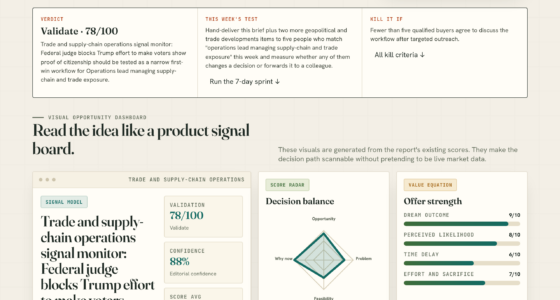
📊 Full opportunity report: Parts Standardization: The Latest Signal From Toyota, Nissan, And Honda on IdeaNavigator AI — validation score, market gap, and execution plan.

Get business pricing on monitors, keyboards and dev gear
- Business-only prices and quantity discounts
- Tax-exempt purchasing
- Multiple users, one account, clear invoices
TL;DR

A business-monitoring brief highlights a proposed story that Toyota, Nissan and Honda may standardize parts to lower costs. The material provides no company announcement, agreement details, timeline or named source confirming that such a plan exists.
A monitoring brief has flagged a possible plan by Toyota, Nissan and Honda to standardize parts to reduce costs, but it offers no evidence that the three automakers have announced or agreed to such a measure. For independent dealerships and repair shops, the distinction matters: shared parts could affect sourcing and service planning, but the claim is not yet a basis for changing purchasing decisions.
The item appears in an IdeaNavigator AI brief about monitoring automotive news for developments that matter to independent dealerships and auto shops. Its headline-like description is “Toyota, Nissan, and Honda to standardize parts to lower costs.” The brief does not identify a company statement, regulatory filing, date, named spokesperson or other reporting that confirms the proposed action.
Instead, the document frames the topic as a possible signal for a retail-focused news-monitoring product. It says a feed could track vehicle launches, recalls and regulation, then summarize relevant developments for dealership owners or sales leads. The brief reports that Hacker News surfaced the item with an 88/100 signal, but gives no definition of that score, its measurement period or a comparison baseline. It should not be treated as evidence of industry agreement or impact.
The proposed validation is also a product test, not confirmation of the automotive claim. IdeaNavigator AI suggests delivering the brief and two other automotive items to five people matching the intended customer profile, then measuring whether they change a decision or forward an item. No results from that test are included.
Parts standardization signal check
A monitoring brief says Toyota, Nissan and Honda may standardize parts to lower costs. It provides no confirmation that the automakers announced or agreed to a plan.
What is known
The item is an early signal in an IdeaNavigator AI brief, not confirmed industry news.
- A headline-like claim links the three automakers to parts standardization.
- The brief reports an 88/100 Hacker News signal score.
- No company statement, filing or named source is provided.
- The score’s method and underlying reporting are not explained.
Why shops should care
Shared components could affect sourcing and repairs, depending on the parts and models involved.
Parts availability
Common components could influence inventory choices and repair lead times.
Premature changes
Changing orders based on an unverified claim could disrupt purchasing or customer guidance.
Details still missing
The brief gives no basis for estimating operational impact or cost savings.
What would confirm it
A company statement or reliable documentation would establish whether a plan exists.
Look for confirmation from Toyota, Nissan or Honda and credible reporting.
Establish participating entities, components, models and timing.
Only then consider changes to stock, supplier plans or customer guidance.
Why Parts Sharing Could Matter
If the automakers do pursue common parts, the practical effects could reach beyond manufacturing costs. A shared component could, depending on which parts and models are involved, influence availability, inventory choices and repair lead times for retailers and service businesses. Those outcomes are possibilities, not reported results of a confirmed plan.
Independent operators often need timely, actionable information to decide what to stock, which repairs may require a longer wait, and what to tell customers. But acting on an unverified headline carries its own risk: a shop could change orders or expectations without knowing whether the announcement is real, which models it covers or when any change would take effect. For now, the useful takeaway is to seek confirmation rather than infer a purchasing or service change.
The monitoring brief points to a separate issue for the sector: relevant news can be scattered across company announcements, filings and other feeds. A role-specific summary could help businesses spot developments sooner, but the value depends on accurate sourcing and clear uncertainty labels, particularly when an initial signal is not confirmed reporting.
Popular right now

KitchenAid Artisan 5-Quart Tilt-Head Stand Mixer, Milkshake

Ninja Foodi 10-Qt DualZone XL Air Fryer, 6-in-1, Grey (DZ401)

Dyson V15 Detect Cordless Stick Vacuum
As an affiliate, we earn on qualifying purchases.
A Retail Monitoring Proposal
IdeaNavigator AI presents the topic as an example for a proposed automotive retail signal monitor, aimed at owners or sales leads at independent dealerships and auto shops. The stated problem is that launches, recalls and regulatory developments appear in multiple places, making it difficult for a small business to identify what affects its work and turn it into a decision.
The suggested minimum product would monitor Hacker News and similar feeds, filter items for the target audience, and produce a short brief explaining what changed, why it matters and what a reader might do. The document proposes a subscription as a possible business model. These are product ideas and a customer-validation plan; they do not establish that a monitor has launched, that customers have subscribed or that the parts-standardization claim has been verified.
The distinction between an early signal and a confirmed industry development is particularly relevant here. A feed ranking can indicate that an item has attracted attention within that feed, but without its scoring method and underlying links, it cannot establish the accuracy of the claim. No earlier timeline or related Toyota, Nissan or Honda announcement is provided in the brief.
The Agreement Details Are Missing
The central uncertainty is whether Toyota, Nissan and Honda have made any agreement to standardize parts. The brief supplies no direct confirmation from the automakers, no documents describing an arrangement and no independent reporting establishing one. It also does not say whether the wording refers to talks, a proposal, an existing standard or a future commitment.
Even if an initiative were confirmed, key details would remain necessary to assess its effect: which components and vehicle models would be covered, whether the companies would share designs or procurement, what the implementation schedule would be, and whether costs or customer prices would change. None of those points is answered. The claimed goal of lowering costs appears in the headline phrasing, but no cost estimate or evidence of savings is given.
The brief also does not explain the 88/100 Hacker News score or identify the posts and reporting behind it. No quotes or named human sources are provided. Until company statements or credible documentation emerge, the parts-standardization item should be treated as unverified, not as an announced policy or completed deal.
Watch for Company Confirmation
The next meaningful development would be a statement or document from Toyota, Nissan or Honda that confirms whether a parts-sharing or standardization effort exists. Any follow-up should establish the scope, participating entities, covered components and timing before describing effects on dealers, repair shops or customers.
For independent businesses, the prudent near-term step is to verify the claim through company announcements and reliable reporting before adjusting stock, supplier plans or customer guidance. The IdeaNavigator AI brief proposes testing whether role-filtered automotive updates change decisions among five dealership or shop leaders, but it reports no test results. That proposed validation and the underlying automaker claim are separate matters, and both remain open.
Source: IdeaNavigator AI
Key Questions
Have Toyota, Nissan and Honda confirmed a parts-standardization agreement?
No confirmation is provided in the monitoring brief. It includes no company announcement, filing or named representative confirming an agreement.
What parts or vehicles would be covered?
The material does not specify any components, vehicle models or markets. Those details would be needed to assess any effect on parts sourcing or repairs.
Does the 88/100 signal score confirm the story?
No. The brief reports the score as a Hacker News signal, but does not explain its method, time window or comparison baseline. It is not evidence that the automakers reached an agreement.
Should dealerships or repair shops change their orders now?
The information provided does not support changing orders. Businesses should wait for reliable confirmation and details about scope and timing before making operational decisions.
Source: IdeaNavigator AI