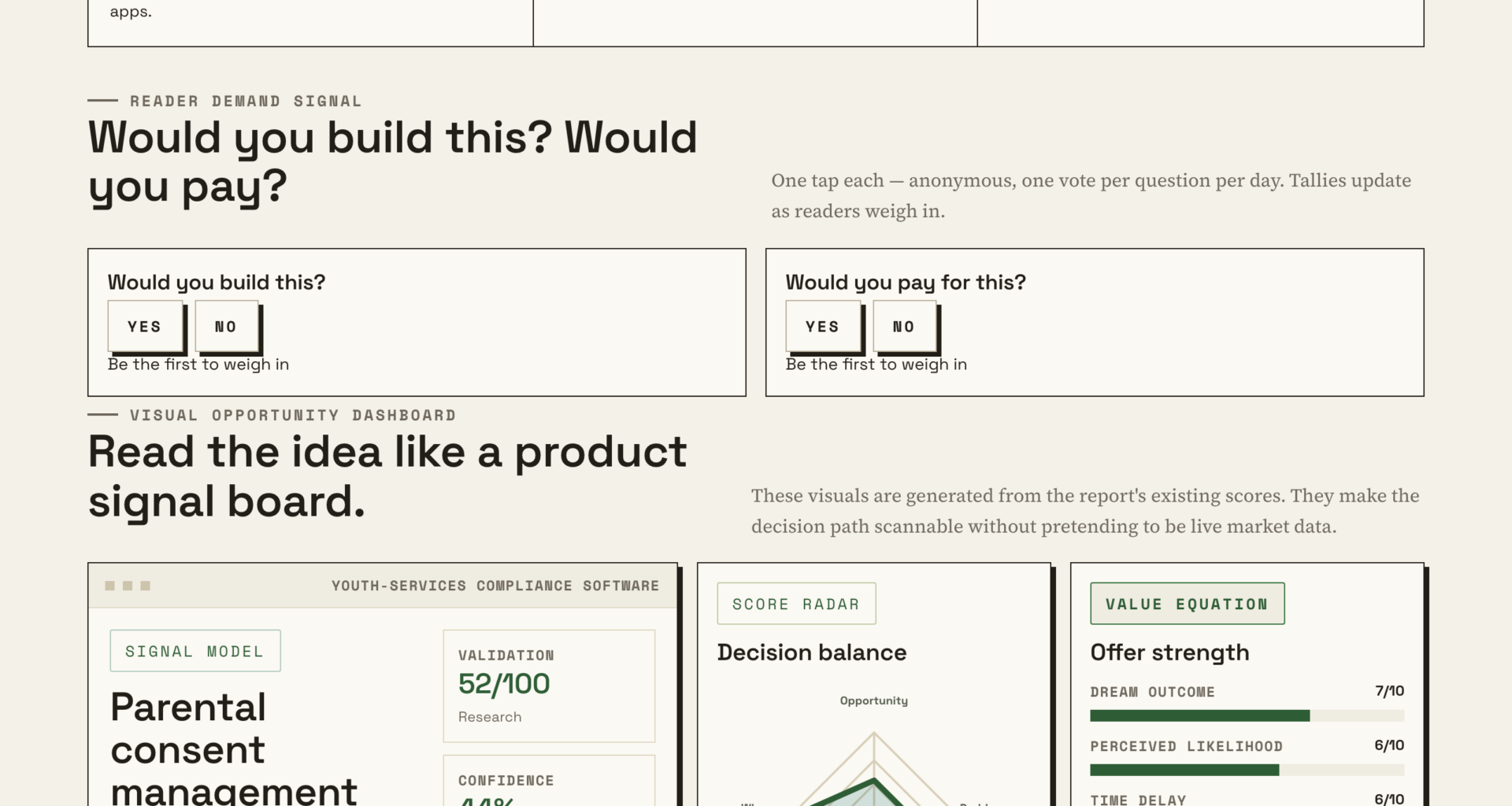

📊 Full opportunity report: How To Keep Parental Consent Processes Organized on IdeaNavigator AI — validation score, market gap, and execution plan.

Get business pricing on monitors, keyboards and dev gear
- Business-only prices and quantity discounts
- Tax-exempt purchasing
- Multiple users, one account, clear invoices
TL;DR

IdeaNavigator AI has proposed a consent-management service for camps, coaches, photographers and youth apps. The concept would give parents phone-based forms and vendors per-child records, but it remains a product proposal; no pilot results, customers or adoption figures are provided.
IdeaNavigator AI has proposed a parental-consent management service for businesses and programs working with children, including camps, coaches, photographers and youth apps. The concept would replace scattered paper forms and email approvals with phone-based consent flows and searchable records, though no launch, customers or completed pilot are reported.
According to IdeaNavigator AI’s proposal, organizations collecting parental permissions may rely on paper forms, email threads and separate records, making it difficult to establish which parent approved which activity. Suggested consent categories include photo use, data collection, medical information and liability waivers. The proposal describes these gaps as a business problem, particularly when a dispute or privacy question arises; it provides no documented cases or measures of how often they occur.
IdeaNavigator AI says the proposed minimum product would let each vendor create branded forms for parents to complete on their phones. It would keep a consent ledger for each child, track expiry dates and offer an audit export. Identity checks would vary with the risk level of the permission, but the proposal does not specify how identity would be verified, what standards would apply or how vendors would protect the resulting records.
The proposed revenue model is a monthly subscription priced by active-child count. To test whether vendors would use the service, IdeaNavigator AI proposes a season-long deployment with ten camps and youth programs. The proposal names consent completion rates and time saved chasing parents compared with paper processes as measures. It identifies no participating programs, timetable, pricing or pilot findings.
Why Youth Vendors Need Clear Records
For organizations that regularly work with children, a consistent record could help staff check whether a permission is current and covers a particular use. A searchable ledger may also make it easier to answer a parent’s question or retrieve documentation when an organization reviews its practices. These are potential benefits of the workflow described in IdeaNavigator AI’s proposal, not results established by a trial.
The proposal also points to a practical tension for small providers: they may need to collect several kinds of permission without having dedicated compliance staff or a purpose-built system. A phone-friendly process could reduce administrative work if families complete it promptly and staff can use the records reliably. Whether a subscription is worthwhile will depend on completion rates, time saved and the cost of adopting it—measures IdeaNavigator AI says a proposed pilot would examine.
From Paper Forms to Digital Ledgers
IdeaNavigator AI frames the proposal around youth-services vendors rather than schools or families broadly. It identifies camps, coaches, photographers and youth apps as possible buyers, and describes the market as youth-services compliance software. Its central premise is that these organizations often assemble consent procedures themselves, using tools that may not provide a single view of who gave permission, for which child, and for what purpose.
IdeaNavigator AI cites changing children’s privacy requirements, including COPPA updates and state laws, as part of the rationale for considering the product. It also points to parents’ challenges to photo and data use. The proposal names no particular legal change, enforcement action or documented increase in complaints. It therefore does not establish that every listed vendor has the same legal duties or that one form would meet requirements across different activities and jurisdictions.
Questions Before a Pilot
IdeaNavigator AI’s proposal reports no product launch or pilot outcome. It does not name a developer, participating vendors or a release date, and it provides no subscription price. It also does not say how parent identity checks would work, what evidence an audit export would contain, how long records would be retained, or how the service would handle corrections and withdrawals of consent.
The legal and operational fit remains open as well. Photo permission, medical information, data collection and liability waivers can involve different decisions and risks. The proposal does not explain how forms would account for those differences, or whether a vendor could tailor them to the rules that apply to its services. Until a pilot is conducted, it is also unknown whether parents would complete digital forms more reliably than paper ones, or whether staff would spend less time following up.
Testing the Ten-Program Plan
IdeaNavigator AI’s proposed next step is a season-long test with ten camps and youth programs. A useful evaluation would report how many consent requests were completed, how that rate compares with the programs’ previous process, and how staff time was measured. The proposal identifies completion and time saved as measures but gives no baseline, evaluation method or start date.
Further details would clarify whether vendors see enough value to pay for a subscription and whether the service can handle different consent types and risk levels in practice. Until those details or pilot results are available, the platform remains a product opportunity under consideration, rather than an established service with demonstrated outcomes.
Source: IdeaNavigator AI
Key Questions
Who is the proposed service for?
IdeaNavigator AI identifies camps, coaches, photographers and youth apps as potential customers: vendors and programs that work with children and collect permissions from parents.
What would the platform do?
The proposed product would provide phone-based consent forms, per-child records, expiry tracking and audit exports. Suggested form topics include photos, data collection, medical information and liability.
Is the service available now?
The proposal does not report a launch, named customers or a completed pilot. It describes a product concept and a possible test with ten youth programs.
How would the idea be evaluated?
The proposed season-long pilot would measure consent completion rates and time saved compared with paper processes. No results, baseline figures or evaluation schedule are provided.
Source: IdeaNavigator AI
Fall Picks
fall essentials
As an affiliate, we earn on qualifying purchases.