📊 Full opportunity report: A Financial Advisor Report Card For Your New Chapter As An Heir on IdeaNavigator AI — validation score, market gap, and execution plan.

Get business pricing on monitors, keyboards and dev gear
- Business-only prices and quantity discounts
- Tax-exempt purchasing
- Multiple users, one account, clear invoices
TL;DR
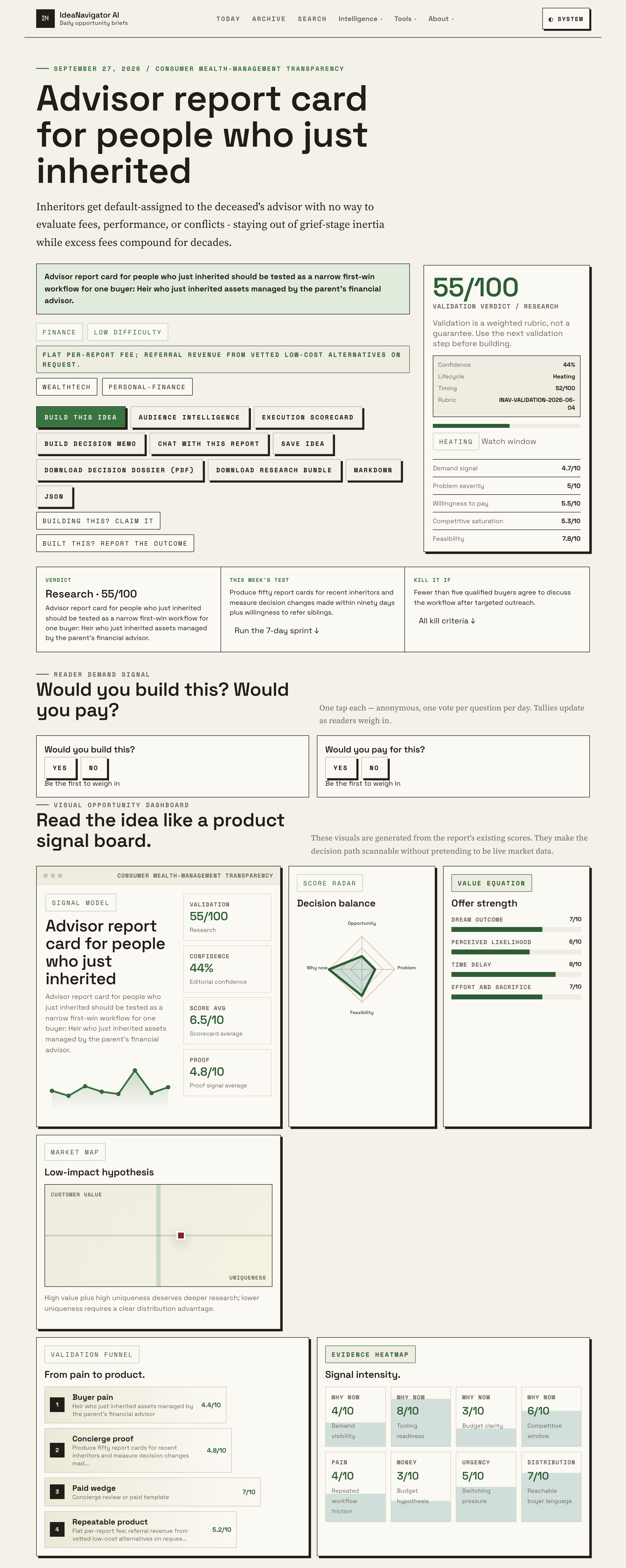
IdeaNavigator AI proposes testing an advisor report card for people who inherit assets managed by a parent’s financial advisor. The concept would analyze documents and public disclosures, but no product launch, test results or evidence of consumer demand are provided.
IdeaNavigator AI has proposed testing a paid advisor report card for people who inherit assets managed by a parent’s financial advisor, offering a way to review fees, regulatory history and disclosed conflicts before deciding whether to stay. The proposal describes an early-stage product concept; it does not report a launch, completed test or measured customer results.
The proposed service would ask an heir to enter the advisor’s name and upload account statements. It would then combine information from public regulatory records, including Form ADV and fee disclosures, with an analysis of the statements to estimate the account’s all-in fees. The report would also describe disclosed conflicts and compare the advisor with alternatives, according to the proposal.
The planned output would offer stay, negotiate or switch guidance, along with scripts for discussing fees or a possible move. The concept would charge a flat fee for each report and could earn referral revenue when a customer requests an introduction to a vetted, lower-cost alternative. The proposal does not name a specific alternative provider or explain how any vetting would work.
IdeaNavigator AI suggests validating the service by producing 50 reports for recent inheritors. The proposed measures are whether recipients change an advisor-related decision within 90 days and whether they would refer siblings. Those are planned tests, not reported findings; no sample has been described as completed.
A Check Before Heirs Stay
Inheriting investments can also mean inheriting an existing advisory relationship. A report that translates account statements and public disclosures into estimated costs could help a new asset holder ask more specific questions before accepting the arrangement by default. That matters because a fee paid repeatedly over years can affect the amount left invested, though the proposal gives no fee examples or estimates of potential savings.
The service would place a decision aid between a potentially unfamiliar heir and an established advisor relationship. Its practical value would depend on whether it can calculate charges accurately, explain comparisons fairly and help people distinguish disclosed conflicts from evidence of misconduct. The proposal describes those functions as product goals; it does not establish that the analysis has been built or independently validated.
Referral payments also create a financial relationship worth making clear to customers. If the report recommends alternatives and the company earns money from referrals, users would need to know when that arrangement applies and how it could affect recommendations. No disclosure or conflict-management policy is specified in the concept.
The Inherited Advisor Relationship
The idea targets a particular situation: an heir receives assets that were managed by the deceased parent’s advisor. It frames the problem as one of limited information and a relationship that may continue by default, rather than a general service for anyone choosing a financial professional.
Its proposed inputs combine two kinds of evidence. Regulatory filings and fee disclosures can provide public information about an advisor and the services or conflicts disclosed. Account statements may reveal charges actually applied to a particular account. The concept would use document-parsing tools, including large language models, to help read those records. It does not detail what records the system would retrieve, how it would verify extracted figures or what a human reviewer would check.
The proposal places the idea in the consumer wealth-management transparency market and points to a broad transfer of wealth to heirs over the coming decade as a reason to explore it. It supplies no estimate of the number of heirs who fit this specific use case, the service’s addressable market or the share likely to pay for a report.
Accuracy, Demand and Incentives
Several key questions remain unanswered because the proposal is a product outline rather than a report of operating results. It does not state whether a working report card exists, when testing might begin, how much a report would cost or how many recent inheritors have expressed interest.
The proposed analysis also raises practical questions about accuracy and completeness. Statements can use different formats and may not show every cost in one place. The outline does not explain how the service would handle missing records, verify its calculations, compare advisors with different services or correct errors. It also gives no detail on data retention and privacy for uploaded financial documents.
Finally, it is unclear how the service would separate an evidence-based recommendation from its potential referral income. No results are available to show whether the tool changes decisions, whether those changes benefit customers or whether users would recommend it to siblings.
Testing the First Fifty Reports
The next step described in the proposal is a pilot producing 50 report cards for recent inheritors. The proposed follow-up would track advisor decisions during the next 90 days and ask whether participants would refer siblings. IdeaNavigator AI has not provided a schedule, recruitment plan or criteria for deciding whether the results justify building the service further.
Any assessment of the concept will depend on details that are still absent: the price, the accuracy checks, how comparisons are selected, how referrals are disclosed and how uploaded statements are protected. Until a pilot or product release supplies those details, the report card remains a proposed workflow rather than a tested consumer service.
Source: IdeaNavigator AI
Key Questions
What is the proposed advisor report card?
It is a proposed paid service for heirs who inherit assets managed by a parent’s advisor. It would review statements and public disclosures to summarize fees, regulatory history and disclosed conflicts.
Can heirs use the service now?
The proposal does not say that the service has launched or that a working version is available. It describes an idea and a possible pilot.
What would the report recommend?
The planned report would offer stay, negotiate or switch guidance and provide scripts for discussions. No completed recommendations or results are reported.
How would the service make money?
The proposed model combines a flat fee for each report with possible referral revenue when users request introductions to vetted, lower-cost alternatives. The proposal does not specify prices or referral safeguards.
How would the concept be tested?
IdeaNavigator AI proposes preparing 50 reports for recent inheritors, then measuring decision changes within 90 days and willingness to refer siblings. No pilot results or start date are given.
Source: IdeaNavigator AI
Halloween Picks
halloween
As an affiliate, we earn on qualifying purchases.