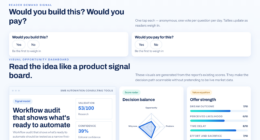

📊 Full opportunity report: Exploring The Impact Of ChatGPT And AI On Scientific Research Efficiency on ThorstenMeyerAI.com — validation score, market gap, and execution plan.

Get business pricing on monitors, keyboards and dev gear
- Business-only prices and quantity discounts
- Tax-exempt purchasing
- Multiple users, one account, clear invoices
TL;DR
OpenAI has launched a program offering free access to its advanced AI models for up to 100,000 researchers. The initiative aims to enhance scientific productivity but its impact on research quality remains unproven.
OpenAI has launched ChatGPT for Academic Researchers, a program offering free access to its frontier AI models and research tools for up to 100,000 scientists, mathematicians, and engineers. For more context, see the original analysis. The initiative begins with an initial cohort of 10,000 researchers in summer 2026 and plans to expand throughout 2027, aiming to democratize access to advanced AI systems in academia. This development is discussed in the impact of AI search.
The program is open to researchers affiliated with recognized, degree-granting institutions with active research programs. Participants will gain access to ChatGPT, ChatGPT Work, Codex, and the upcoming GPT-5.6 models, with increased usage limits, larger context windows, and specialized tools for fields like genomics, protein modeling, and drug discovery. Researchers can invite up to four collaborators, with data privacy protections in place, and default settings ensure data is not used for model training.
OpenAI’s initiative aims to lower the cost barrier for research labs with limited resources, potentially streamlining workflows such as literature review, data analysis, coding, and manuscript drafting. The program is part of a broader commitment of over $250 million through 2027 to support external scientific research, including collaborations with government agencies. However, the actual impact on research outcomes remains to be seen, as no peer-reviewed evidence currently confirms improvements in scientific productivity or accuracy.
Potential Impact of AI Access on Scientific Research
The program could significantly reduce costs and increase access to advanced AI tools for researchers worldwide, especially those in less-funded institutions. By integrating AI into routine research workflows, it has the potential to accelerate discoveries and streamline data processing. Nonetheless, the quality and reliability of research outcomes generated with AI assistance are still unverified, and human oversight remains essential. The initiative’s success could influence future funding, collaboration models, and the pace of scientific innovation, but definitive evidence of improved results has yet to be established.
Popular right now

Bose QuietComfort Headphones (2nd Gen), Wireless Noise-Cancelling Over-Ear Headphones, Eucalyptus Green

Dyson Cyclone V10 Origin Cordless Vacuum

TCL 85 Designer Series QD-Mini LED TV (Model 85A400U) with Google Smart TV
As an affiliate, we earn on qualifying purchases.
Background on AI in Scientific Research
Over recent years, AI tools like ChatGPT have gained widespread use in academia for tasks such as literature review, coding, and data analysis. Despite rapid adoption, access has often been limited to well-funded labs with substantial computing resources. Previous efforts to integrate AI into research workflows have faced challenges related to cost, data privacy, and model reliability. OpenAI’s new program aims to address these barriers by offering free, scalable access to its most advanced models, potentially transforming how research is conducted across disciplines.
Unanswered Questions About Program Effectiveness
It remains unclear whether access to OpenAI’s models will meaningfully improve research quality, reproducibility, or publication rates. No independent studies have yet evaluated the long-term impact of this initiative on scientific progress. Additionally, details about application prioritization, data privacy in different countries, and the duration of free access are still emerging. The actual influence on research workflows and outcomes will depend on how researchers adopt and validate AI-generated results.
Next Steps in AI-Enhanced Scientific Research
OpenAI will begin onboarding the initial 10,000 researchers in summer 2026, collecting feedback to refine the program. As enrollment expands toward 100,000 participants, the company plans to publish further details on eligibility, usage policies, and the impact on research productivity. Independent evaluations and peer-reviewed studies will be needed to assess whether this access translates into faster, more reliable scientific discoveries.
Key Questions
Who is eligible to participate in the OpenAI research program?
Researchers affiliated with recognized, degree-granting institutions actively engaged in research, who verify their institutional affiliation and scientific intent, are eligible to apply.
Will data from research using these AI tools be used to train OpenAI models?
OpenAI has stated that, by default, data from the program will not be used for training, but researchers should review their institution’s policies before sharing sensitive or unpublished data.
Does access to these AI tools guarantee better research outcomes?
There is currently no peer-reviewed evidence confirming that AI access improves research quality or speed. Effectiveness will depend on how researchers validate and integrate AI-generated results.
How long will researchers have free access to the tools?
Details about the duration of free access and specific usage limits are still being finalized and will be communicated as the program progresses.
Source: ThorstenMeyerAI.com