📊 Full opportunity report: Mac vs GPU Tower for Local LLMs: The Heat-and-Noise Tradeoff on ThorstenMeyerAI.com — validation score, market gap, and execution plan.

Get monitors, keyboards and dev gear delivered free — and shop member deals
- Fast, free delivery on millions of items
- Access to Prime Big Deal Days deals on October 6–7
- Prime Video, Amazon Music and more included
TL;DR
This article compares Apple Silicon Macs and GPU towers for running local large language models, focusing on heat, noise, capacity, and performance tradeoffs. The choice depends on model size, throughput needs, and noise tolerance.
Apple Silicon Macs, such as the Mac Studio with M3 Ultra, offer near-silent operation and low power consumption for local large language model (LLM) inference, contrasting sharply with high-performance GPU towers that generate significant heat and noise.
The comparison hinges on two key architectural differences: bandwidth versus capacity. GPU towers, equipped with high-bandwidth RTX 5090 cards, deliver roughly 1,792 GB/s of memory bandwidth, enabling faster token generation for models fitting within VRAM limits. However, they consume 575W or more, producing substantial heat that requires complex thermal management, cooling, and noise mitigation efforts. Conversely, Apple Silicon chips like the M3 Ultra optimize for capacity with a unified memory architecture, supporting up to 512GB of shared memory, allowing them to run large models (70B+ parameters) that exceed GPU VRAM limits. These Macs operate quietly and efficiently, making them suitable for always-on, desktop AI workloads but with slower inference speeds. The tradeoff is clear: GPU towers excel in throughput and fine-tuning, while Macs excel in silence and power efficiency for large models that cannot fit in GPU VRAM.Mac vs GPU tower
for local LLMs.
What if you sidestep the heat entirely with a different kind of machine? A tower is a high-bandwidth furnace you spend five levers quieting. Apple Silicon is near-silent by design — but asks for different tradeoffs. Match your priority in Part 2.
Put the loud, hot machine where its noise doesn’t matter, and the quiet one where you do. SSH into the tower when you need raw power; let the Mac handle everything else, silently.
Implications for Local AI Deployment Choices
This comparison impacts how AI practitioners and enthusiasts choose hardware based on workload priorities. For latency-sensitive applications requiring maximum throughput on smaller models, GPU towers remain superior. However, for users prioritizing quiet operation, power efficiency, and running very large models without extensive thermal management, Apple Silicon Macs offer a compelling alternative. The decision influences not just performance but also operational costs, noise levels, and workspace comfort, especially for continuous, on-desk AI use.
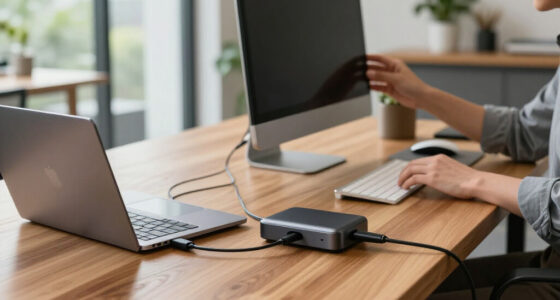
Apple Mac Studio M3 Ultra for AI inference
As an affiliate, we earn on qualifying purchases.
As an affiliate, we earn on qualifying purchases.
Evolution of Hardware for Local Large Language Models
Traditionally, GPU towers with NVIDIA cards have been the default for local AI due to their high bandwidth and ecosystem support, including CUDA. Recent developments in Apple Silicon, with increased unified memory and optimized architecture, challenge this paradigm by enabling large-model inference on a desktop without the thermal and noise overhead of GPU rigs. This shift reflects broader trends toward energy efficiency and simplicity in AI hardware, driven by the limitations of GPU heat dissipation and noise management, alongside improvements in Apple Silicon's MLX ecosystem.
"The heat-and-noise tradeoff is a fundamental consideration when choosing between a GPU tower and a Mac for local AI. It’s not just about speed; it’s about operational comfort and hardware longevity."
— Thorsten Meyer
GPU tower with RTX 5090 for machine learning
As an affiliate, we earn on qualifying purchases.
As an affiliate, we earn on qualifying purchases.
Unresolved Questions About Long-Term Scalability
It remains unclear how Apple Silicon's performance scales with future large models, and whether software ecosystem limitations will hinder broader adoption for training or fine-tuning. Additionally, the long-term durability of sustained inference workloads on Macs compared to GPU towers has not been fully tested.
high-performance AI workstation GPU
As an affiliate, we earn on qualifying purchases.
As an affiliate, we earn on qualifying purchases.
Upcoming Hardware and Software Developments
Expect further improvements in Apple Silicon’s memory capacity and inference speed, as well as potential software ecosystem enhancements to support more advanced AI workflows. On the GPU side, new cards and multi-GPU configurations may push throughput limits further, but with increased thermal and noise challenges. Industry trends suggest ongoing innovation to balance performance, efficiency, and operational noise.
quiet desktop for large language models
As an affiliate, we earn on qualifying purchases.
As an affiliate, we earn on qualifying purchases.
Key Questions
Can a Mac run large language models as effectively as a GPU tower?
Macs can run large models (70B+ parameters) that do not fit in GPU VRAM, but generally at slower inference speeds. They excel in silent, power-efficient operation but may not match GPU towers in raw throughput for smaller, latency-sensitive tasks.
Is heat and noise the main reason to choose between a Mac and GPU tower?
Heat and noise are significant factors, especially for continuous, desk-side AI workloads. GPU towers produce substantial heat and require complex thermal management, while Macs operate quietly and efficiently by design. The choice depends on workload size, speed requirements, and workspace preferences.
Will future Apple Silicon updates improve large model inference performance?
Potential hardware upgrades, such as increased memory capacity and faster neural engines, could enhance large-model inference on Macs. However, current ecosystem and architectural limits mean that performance gains may be incremental until new generations are released.
Can Macs be used for training models, or only inference?
Currently, Macs are primarily suited for inference of large models due to hardware and ecosystem limitations. Training large models still favors GPU towers with CUDA support and multiple GPUs for scalability and ecosystem compatibility.
Source: ThorstenMeyerAI.com
Fall Picks
fall essentials
As an affiliate, we earn on qualifying purchases.