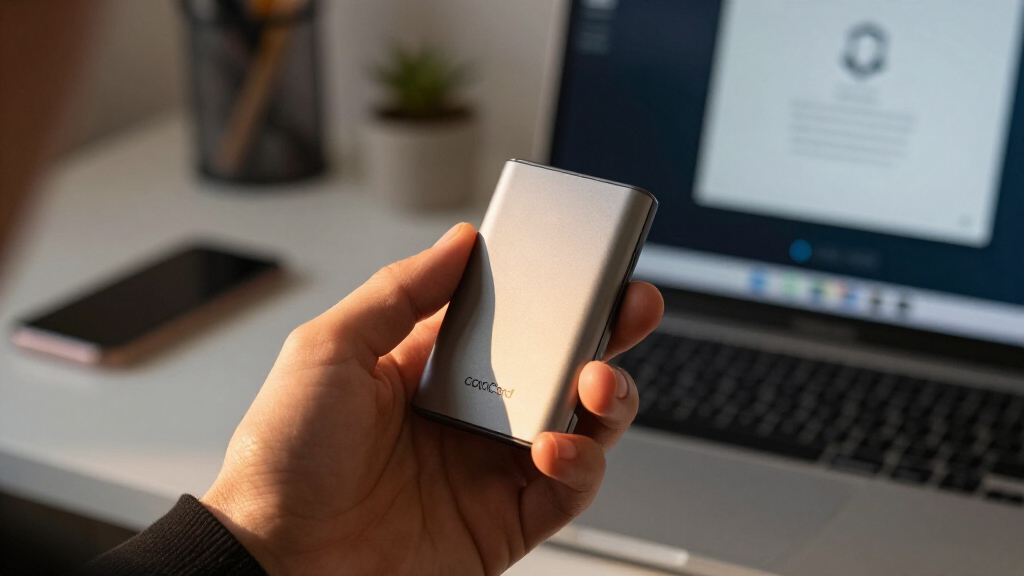

📊 Full opportunity report: The ColdCard Hack And The Wake-Up Call For AI In Security on ThorstenMeyerAI.com — validation score, market gap, and execution plan.

Get business pricing on monitors, keyboards and dev gear
- Business-only prices and quantity discounts
- Tax-exempt purchasing
- Multiple users, one account, clear invoices
TL;DR
A flaw in a well-known hardware wallet’s firmware was exploited to steal over $70 million in Bitcoin. While AI’s involvement remains unconfirmed, this incident underscores the emerging role of AI in security breaches. The event signals a new era of digital vulnerabilities affecting all sectors, which can be further explored in our article on who really found the Coldcard hack.
On July 30, hackers drained 1,082 Bitcoin, worth approximately $70 million, from nearly 1,200 wallets using a flaw in a popular hardware wallet’s firmware. This attack, carried out through a previously undiscovered bug, affected even highly security-conscious users, highlighting vulnerabilities in hardware security and raising broader concerns about AI’s role in cybersecurity threats.
The breach was made possible by a firmware update in March 2021 that inadvertently rerouted the wallet’s key generation process from a hardware random-number generator to a deterministic software fallback. This change significantly reduced the entropy of generated keys, making them searchable and vulnerable to brute-force attacks. Once the flaw was identified, attackers used automated scripts to generate private keys, check their associated public addresses on the blockchain, and systematically drain wallets with balances, completing the theft in under an hour.
The company behind the wallet, Coinkite, acknowledged the error, with CEO Rodolfo Novak attributing the flaw to an engineering oversight. Notably, Coinkite had conducted an AI-assisted firmware audit just weeks before the breach, which failed to detect the vulnerability. This raises questions about AI’s effectiveness in preemptively identifying security flaws, especially in complex codebases.
A firmware error shrank the pool that “random” keys were drawn from. A searchable pool is a drainable one. Here is the mechanism, conceptually — no operational detail.
A March 2021 firmware update rerouted key generation from the device’s hardware random-number generator to a deterministic software fallback — drawing seeds from a dramatically smaller universe.
Once the flaw is understood, the whole attack runs on an ordinary machine — no internet needed until the final move.
Implications for AI and Hardware Security
This incident underscores the increasing importance of AI in cybersecurity, both as a tool for identifying vulnerabilities and as a potential factor in executing sophisticated attacks. As AI models become more capable, the risk of them being used maliciously or failing to detect vulnerabilities grows, prompting urgent discussions about integrating AI safety measures into security protocols. The breach also highlights that even highly trusted hardware solutions are vulnerable if their firmware contains undetected flaws, emphasizing the need for rigorous testing and AI-assisted review processes.
hardware wallet with secure firmware
As an affiliate, we earn on qualifying purchases.
As an affiliate, we earn on qualifying purchases.
The Evolution of Hardware Wallet Security and AI's Role
Hardware wallets have long been considered among the most secure methods for storing cryptocurrencies, relying on the assumption that private keys are generated and stored offline. However, this incident reveals that firmware updates—if not thoroughly vetted—can introduce critical vulnerabilities. The breach occurred after a firmware update that shifted key generation from hardware to software, a change that went unnoticed for years. The timing of the attack suggests a possible link to recent advances in open-source AI models, which have accelerated code review and vulnerability detection but also enable new attack vectors. Experts note that AI-assisted audits are becoming standard, but their limitations are now evident.
"This is the sober reality of a new AI paradigm, where AI-assisted code review can surface latent bugs faster than industry experts."
— Rodolfo Novak, CEO of Coinkite
As an affiliate, we earn on qualifying purchases.
Unclear Role of AI in the Attack Process
There is no confirmed evidence that AI directly facilitated the attack. While the timing and sophistication suggest AI involvement, current public information attributes the breach primarily to human engineering error. It remains unknown whether AI was used to discover the bug, generate attack scripts, or both, and investigations are ongoing.
hardware wallet security accessories
As an affiliate, we earn on qualifying purchases.
As an affiliate, we earn on qualifying purchases.
Next Steps for Industry and AI Security Measures
Security experts and hardware manufacturers are expected to review their firmware testing protocols, with an increased focus on AI-assisted audits. Industry-wide, there may be a push for more transparent AI integration in security processes, alongside enhanced manual verification. Regulators could also step in to establish standards for AI use in cybersecurity, aiming to prevent similar vulnerabilities in the future. Meanwhile, affected users are advised to review their security practices and monitor blockchain activity for suspicious transactions.
cold storage cryptocurrency wallet
As an affiliate, we earn on qualifying purchases.
As an affiliate, we earn on qualifying purchases.
Key Questions
Could this type of vulnerability happen to other hardware wallets?
Yes, if firmware updates are not thoroughly tested, similar vulnerabilities could affect other devices, especially as AI tools become more integrated into development and review processes.
Is AI responsible for the breach?
There is no public proof that AI directly caused the breach. The current understanding attributes it to human error, though AI's role in discovering or executing the attack remains a subject of investigation and speculation.
What can users do to protect themselves now?
Users should review their security measures, consider hardware wallet firmware updates carefully, and stay informed about potential vulnerabilities. Monitoring blockchain activity for unusual transactions is also recommended.
Will this impact the trust in hardware wallets?
This incident may prompt a reevaluation of hardware wallet security protocols and increase demand for AI-verified firmware, but it does not necessarily diminish overall trust if industry standards improve.
Source: ThorstenMeyerAI.com
Halloween Picks
halloween
As an affiliate, we earn on qualifying purchases.