TL;DR

Get business pricing on monitors, keyboards and dev gear
- Business-only prices and quantity discounts
- Tax-exempt purchasing
- Multiple users, one account, clear invoices
A report by Bosscher describes running a collection of self-hosted services on a $10 OpenStick, a small ARM device with 512 MB of RAM and 4 GB of storage. The setup includes DNS filtering, service monitoring, RSS and bookmark tools, alongside an AI agent; reported memory figures come from the author and are not independent benchmarks.
Bosscher has described running a small collection of self-hosted services on a $10 OpenStick, a passively cooled device with 512 MB of RAM and 4 GB of eMMC storage. The report illustrates how modest hardware can support selected home-server tasks, but the author’s software choices and performance figures are personal observations, not independent tests.
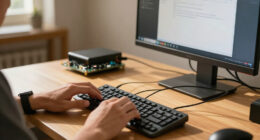
The OpenStick has four 1 GHz ARM Cortex-A53 cores, about 450 MB of usable RAM according to Bosscher, Wi-Fi, a 4G modem and GPS. The author says setup requires some work, after which the device runs Debian, including systemd and Podman. Its passive cooling means it runs without a fan, though the report provides no power-consumption measurements.
Services described include AdGuard Home for DNS-based domain blocking, CastSponsorSkip for Google Cast devices, and Cloudflare Tunnel for reaching services without directly opening ports. Bosscher says about 60% of DNS queries are blocked after adding blocklists; the report does not give the measurement period, query count or a comparison baseline, and the percentage reflects the author’s own setup.
The other applications cover different tasks: Beszel monitors system resources and sends alerts, while Gatus checks whether services are available. Dozzle provides a container log interface; Fusion handles RSS feeds; and Shiori manages bookmarks and archives pages. Bosscher also runs Zeroclaw, an AI-agent framework, mainly to ask about system logs and disk space through Telegram. The author reports roughly 3 MB of idle memory use for Zeroclaw, but does not specify test conditions or version.
Small Hardware, Several Home Services
The setup matters to readers interested in low-cost self-hosting because it offers a concrete example of putting a limited, inexpensive device to use beyond experimentation. DNS filtering, service checks, feeds and bookmarks are relatively distinct jobs, and the author’s account shows how lightweight tools can be combined rather than running a larger monitoring stack.
It is not evidence that every listed application will run smoothly together on every OpenStick. Available memory and storage are constrained, and the report does not publish sustained load tests, reliability data or energy readings. The practical takeaway is narrower: Bosscher says this particular collection meets their needs, while noting that the installation takes effort and that some services may be optional.
Popular right now

iRobot Roomba Plus 678 Robot Vacuum and Mop with AutoWash Dock

Dyson Supersonic Nural Hair Dryer

Ninja Espresso and Coffee Maker with Built-In Frother, CFN601
As an affiliate, we earn on qualifying purchases.
From Novelty Device to Debian Server
Bosscher says the purchase was initially an impulse buy, prompted by the device’s low price and unusual capabilities. The author presents it as an entry point to self-hosting, with Debian providing familiar Linux service management and Podman container support. The report contrasts compact tools with a previous Kubernetes setup, which Bosscher says felt excessive for some personal monitoring tasks.
The software choices reflect trade-offs described by the author rather than a formal comparison. Bosscher says Zeroclaw used less memory than OpenClaw in their experience and preferred its documentation and community activity over alternatives. For monitoring, the author favored Beszel over a Grafana-based stack for ease of use and lower resource demands. No controlled comparisons or independent verification are supplied.
“For 10 dollars you basically get a home server with minimal power usage and zero noise!”
— Bosscher
Performance and Security Limits
The report does not state when the measurements were taken, identify the software versions, or provide repeatable tests. It is unclear how the services behave under simultaneous heavy use, how much storage the complete installation consumes, or how much electricity the OpenStick draws. The 60% blocked-query figure has no stated observation period or baseline.
Security also depends on configuration. Bosscher says Zeroclaw has access to the OpenStick in a way the author describes as effectively a root shell, while limiting its reach to that device. The report does not detail the full safeguards or threat model. Bosscher also notes that DNS blocking cannot stop every unwanted connection and that Cloudflare Tunnel involves a trust trade-off. These are the author’s judgments, not independent security evaluations.
Further Changes to the Setup
Bosscher says a planned Zeroclaw version may add rich-message support for Telegram, with the author’s contribution tracked in a pull request. The report does not give a release date. The author also says Dozzle could be removed if memory becomes tight, since its functions overlap partly with Beszel.
For readers considering a similar build, the next step would be checking current OpenStick availability, installation instructions and software requirements before buying or deploying services. Bosscher’s account is a snapshot of one personal setup; future reports or version-specific measurements would be needed to establish how well the combination performs for other users.
Key Questions
What is the OpenStick in this report?
Bosscher describes it as a $10 passively cooled device with four 1 GHz ARM Cortex-A53 cores, 512 MB of RAM and 4 GB of eMMC storage. It also has Wi-Fi, a 4G modem and GPS.Which services does Bosscher run?
The reported setup includes AdGuard Home, CastSponsorSkip, Zeroclaw, Cloudflare Tunnel, Beszel, Dozzle, Gatus, Fusion and Shiori, covering DNS filtering, monitoring, container logs, RSS and bookmark archiving.Can the device run all of these services comfortably?
Bosscher says the applications work for this setup, but the report does not provide controlled performance tests or show how they behave under heavy simultaneous use. The device has limited RAM and storage, so results may depend on configuration and workload.Does the report prove the setup uses very little electricity?
No. Bosscher describes the server as using minimal power, but provides no measured power-consumption figures. Passive cooling confirms there is no fan, not how much electricity the device uses.Source: blog.bosscher.ch