

Developer laptop docking stations can turn a single laptop connection into a workspace for external displays, wired networking, storage, and peripherals. My best overall pick is the Lenovo ThinkPad Thunderbolt 4 Dock for a stable, high-bandwidth setup, while the Plugable Thunderbolt 4 Dock stands out for dual HDMI and 100W charging, and the Selore 17-in-1 suits workstations that need many connections and triple-display support. The main tradeoffs are Thunderbolt bandwidth and broad compatibility versus lower-cost USB-C hubs, plus native display output versus DisplayLink software and its setup requirements. Charging capacity, monitor resolution, and your laptop’s port capabilities can change which dock is the right match. Continue reading for the full comparison, buying advice, and picks by developer workflow.

Get business pricing on monitors, keyboards and dev gear
- Business-only prices and quantity discounts
- Tax-exempt purchasing
- Multiple users, one account, clear invoices
Key Takeaways
- Thunderbolt docks lead for bandwidth-dependent workflows: The Lenovo ThinkPad and Plugable Thunderbolt 4 models are the clearest fits for developers who connect fast storage, displays, and other peripherals through one cable.
- Display count alone does not tell the whole story: Several docks advertise multiple displays, but buyers should check resolution, refresh rate, operating-system support, and whether DisplayLink software is required.
- High port counts favor desk-bound setups: The Selore 17-in-1 and TobenONE models offer broad connectivity and multi-monitor options, but their larger feature sets may be unnecessary for a laptop-and-one-monitor workspace.
- Compact hubs trade expansion for portability: The Anker 8-in-1 and Acer 9-in-1 are easier to carry than full docking stations, though they offer less room for a fixed, cable-heavy workstation.
- Host-laptop compatibility is the deciding check: USB-C, Thunderbolt, charging, and video capabilities vary by laptop; a dock cannot add display functions the host port does not support unless its design uses a separate graphics solution.
| WAVLINK DisplayLink Docking Station for Dual 4K Monitors |  | Best for Mixed-Connector Dual Displays | Display technology: DisplayLink; driver required for video output | Maximum displays: 2 | Maximum display resolution: 4K@60Hz | VIEW LATEST PRICE | See Our Full Breakdown |
| Acer 9-in-1 USB-C Docking Station with Dual HDMI |  | Best Value for a Charging Desk Setup | Total ports: 9 | Video outputs: 2 HDMI, up to 4K@60Hz | USB ports: 3 USB-A and 1 USB-C, up to 5 Gbps | VIEW LATEST PRICE | See Our Full Breakdown |
| HP USB-C 100W G6 Dock with Extra USB-C Cable |  | Best for High-Refresh Single-Display Work | Power delivery: Up to 100W | Total ports: 10, including 5 USB ports | Video output: 1 HDMI 2.1; up to 4K at 120Hz | VIEW LATEST PRICE | See Our Full Breakdown |
| Dell Pro WD25 USB-C Docking Station |  | Best for Multi-Display Development Desks | Maximum displays: Up to 4 high-resolution displays | USB-C power delivery: Up to 100W | Total ports: 10 | VIEW LATEST PRICE | See Our Full Breakdown |
| Selore 17-in-1 Laptop Docking Station with Triple 4K Display Support |  | Best for Port-Dense Windows Setups | Total ports: 17 | Video ports: 3 HDMI and 2 DisplayPort | Windows display support: Up to 3 extended displays via MST | VIEW LATEST PRICE | See Our Full Breakdown |
| Dell D6000S Universal Docking Station |  | Best for Mixed USB-C and USB-A Setups | Connections: USB-C and USB-A | Display support: Up to three 4K displays | USB ports: 5 | VIEW LATEST PRICE | See Our Full Breakdown |
| Anker Nano 13-in-1 Laptop Docking Station with Detachable 6-in-1 USB-C Hub |  | Best for Desk-to-Travel Flexibility | Total ports: 13 | Display outputs: 2× HDMI and 1× DisplayPort | Display support: Up to 4K at 60Hz single; dual 2K at 60Hz; triple 1080p at 60Hz | VIEW LATEST PRICE | See Our Full Breakdown |
| Lenovo ThinkPad Thunderbolt 4 Docking Station with 90W Adapter | 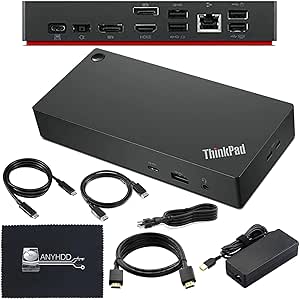 | Best for ThinkPad Desk Setups | Model: 40AY0090US | Display support: 4K | Power adapter: 90W | VIEW LATEST PRICE | See Our Full Breakdown |
| MOKiN 14-in-1 USB-C Laptop Docking Station with HDMI and DisplayPort |  | Best for Port Variety | Total ports: 14 | Video outputs: 2 HDMI and 2 DisplayPort | Display support: Up to three external displays; up to 4K | VIEW LATEST PRICE | See Our Full Breakdown |
| Plugable Thunderbolt 4 Dock with 100W Charging and Dual HDMI |  | Best for High-Bandwidth Developer Workstations | Interface: Thunderbolt 4 | Total ports: 13 | Display support: Dual 4K at 60Hz or single 8K on compatible systems | VIEW LATEST PRICE | See Our Full Breakdown |
| Anker 8-in-1 USB-C Hub with Dual HDMI and 85W Power Delivery |  | Best Compact Pick | Ports: 8 | Display outputs: 2 HDMI | Single-display resolution: Up to 4K at 60Hz | VIEW LATEST PRICE | See Our Full Breakdown |
| Plugable USB 3.0 Universal Laptop Docking Station with Dual HDMI |  | Best for Basic Office Setups | Model: UD-3900 | Host connection: USB 3.0 or USB-C | Video outputs: 2 HDMI | VIEW LATEST PRICE | See Our Full Breakdown |
| Plugable USB-C Triple Display Docking Station with 100W Power Delivery |  | Best for Three-Screen Productivity | Interface: USB Type-C | Display outputs: 3 HDMI | Display configuration: Up to 1× 4K at 30Hz and 2× 1080p at 60Hz | VIEW LATEST PRICE | See Our Full Breakdown |
| Plugable 13-in-1 USB-C Triple Monitor Docking Station with 100W Charging |  | Best for a Full-Service Developer Desk | Total ports: 13 | Display outputs: 3 HDMI; up to three extended displays | Display resolution: HDMI 1: up to 4K at 30Hz; HDMI 2 and 3: up to 1920×1200 at 60Hz | VIEW LATEST PRICE | See Our Full Breakdown |
| TobenONE DisplayLink Docking Station for 3 Monitors with 120W Power Adapter |  | Best for High-Resolution Multi-Monitor Setups | Technology: DisplayLink | Total ports: 18 | Display outputs: 3 HDMI and 3 DisplayPort | VIEW LATEST PRICE | See Our Full Breakdown |
| developer laptop docking station | Total ports | Compatibility |
|---|---|---|
| WAVLINK DisplayLink Docking St | — | — |
| Acer 9-in-1 USB-C Docking Stat | 9 | — |
| HP USB-C 100W G6 Dock with Ext | 10, including 5 USB ports | Most USB-C or Thunderbolt laptops |
| Dell Pro WD25 USB-C Docking St | 10 | — |
| Selore 17-in-1 Laptop Docking | 17 | — |
| Dell D6000S Universal Docking | — | — |
| Anker Nano 13-in-1 Laptop Dock | 13 | USB-C and Thunderbolt 3/4/5 laptops; Windows 10 and macOS 13 Ventura or later |
| Lenovo ThinkPad Thunderbolt 4 | 11 | — |
| MOKiN 14-in-1 USB-C Laptop Doc | 14 | Thunderbolt 3/4 or full-function USB-C laptops |
| Plugable Thunderbolt 4 Dock wi | 13 | Windows 10 and later; compatible Thunderbolt 4, Thunderbolt 5, and USB4 systems |
| Anker 8-in-1 USB-C Hub with Du | — | USB-C, USB4, Thunderbolt, Windows 10/11, and ChromeOS; not compatible with Linux |
| Plugable USB 3.0 Universal Lap | — | Windows 10 or later, macOS 14 or later, and ChromeOS 100 or later; not Linux/Unix |
| Plugable USB-C Triple Display | — | Compatible USB-C, USB4, and Thunderbolt systems; Windows 10/11, macOS 11 or later, and ChromeOS 100 or later |
| Plugable 13-in-1 USB-C Triple | 13 | USB-C, USB4, or Thunderbolt; Windows 10+, macOS 11+, and ChromeOS |
| TobenONE DisplayLink Docking S | 18 | Thunderbolt 3/4/5, USB4, or full-featured USB-C; Windows 10+, macOS 11+, ChromeOS 100+, and Android |
More Details on Our Top Picks
WAVLINK DisplayLink Docking Station for Dual 4K Monitors
I’d pick the WAVLINK when a developer needs two 4K displays and wants freedom to mix HDMI and DisplayPort cables. Its DisplayLink video support can help connect multiple screens across compatible USB and Thunderbolt hosts, while six USB-A ports leave room for a keyboard, mouse, storage, and other desk gear. Compared with the Acer 9-in-1, it has more USB-A connections and does not depend on a USB-C DisplayPort Alt Mode video path, but it does not charge the laptop. DisplayLink also requires a driver, and this dock is a poor fit for Linux, gaming, high-frame-rate editing, or DRM-protected streaming. I’d favor the Acer for a simpler charging-and-display setup; the WAVLINK makes more sense when port flexibility matters more than a one-cable power connection.
Pros:- Connects up to two displays at 4K@60Hz
- Allows flexible HDMI and DisplayPort monitor combinations
- Six USB-A ports plus Gigabit Ethernet and 3.5 mm audio
- Supports a range of USB and Thunderbolt host connections
Cons:- Does not provide laptop charging
- Requires the DisplayLink driver for video output
- Not compatible with Linux and has limitations for gaming, high-frame-rate editing, and DRM-protected streaming
Best for: Developers on compatible Windows, macOS, or ChromeOS laptops who need two 4K monitors, several USB-A peripherals, and mixed HDMI/DisplayPort connections.
Not ideal for: Linux developers, laptop owners who want charging through the dock, or users whose work depends on gaming, high-frame-rate editing, or DRM-protected video.
- Display technology:DisplayLink; driver required for video output
- Maximum displays:2
- Maximum display resolution:4K@60Hz
- Video ports:2 HDMI and 2 DisplayPort
- USB ports:6 USB 3.0 Type-A, up to 5 Gbps
- Additional ports:Gigabit Ethernet and 3.5 mm audio
- Compatible operating systems:Windows 10 and later, macOS 11 and later, ChromeOS 100 and later; not Linux
- Laptop charging:Not supported
Our verdict“Choose the WAVLINK if you need flexible dual-4K monitor connections and abundant USB-A ports, and can supply laptop power separately.”
Acer 9-in-1 USB-C Docking Station with Dual HDMI
The Acer is a practical match for developers who want two HDMI monitors and laptop charging without moving to a larger, more specialized dock. It supplies up to 90W to a compatible laptop and adds USB-A, USB-C, SD, and MicroSD connections, making it a better fit than the WAVLINK for a desk where one cable should handle display, peripherals, and power. The tradeoff is that the host needs USB-C DisplayPort Alt Mode, and the required 100W-or-higher power adapter is not included. Its dual-display behavior on macOS can also vary by configuration, so I’d check the specific laptop setup before relying on independent screens. Compared with HP’s USB-C 100W G6, Acer gives you two HDMI outputs and card readers, while HP offers a single HDMI port with support for 4K at up to 120Hz.
Pros:- Supports two HDMI displays at up to 4K@60Hz
- Delivers up to 90W laptop charging
- Includes USB-A, USB-C, SD, and MicroSD connections
- Aluminum enclosure, built-in cable, and lock button
Cons:- Requires a USB-C port with DisplayPort Alt Mode for video
- 100W-or-higher power adapter is required but not included
- Mac display output and configurations have limitations
Best for: Developers with a USB-C DisplayPort Alt Mode laptop who want two HDMI screens, up to 90W charging, and built-in SD and MicroSD readers.
Not ideal for: Owners of laptops without USB-C DisplayPort Alt Mode, Mac users who require a particular independent-display layout, or buyers who do not already have a suitable high-wattage adapter.
- Total ports:9
- Video outputs:2 HDMI, up to 4K@60Hz
- USB ports:3 USB-A and 1 USB-C, up to 5 Gbps
- Card readers:SD and MicroSD, up to 104 Mbps
- Power input:Up to 100W
- Laptop charging output:Up to 90W
- Host requirement:USB-C with DisplayPort Alt Mode
- Enclosure and cable:Aluminum alloy; built-in 0.65 ft cable
Our verdict“Pick the Acer for a straightforward dual-HDMI workstation with charging and card readers, provided your laptop supports USB-C DisplayPort Alt Mode.”
HP USB-C 100W G6 Dock with Extra USB-C Cable
For a developer who prioritizes a fast, high-resolution main monitor over a large display array, the HP G6’s standout is HDMI 2.1 with 4K support up to 120Hz. That can make scrolling, window movement, and visual work feel more fluid on a compatible display than the Acer’s 4K@60Hz HDMI outputs. It also delivers up to 100W of laptop power and includes 2.5 Gbps Ethernet, a useful pairing for a wired workstation with demanding network transfers. The main limitation is its single HDMI output, so the Dell Pro WD25 is the stronger fit for developers planning a multi-monitor desk. HP lists Windows 11 as the operating system, which narrows its appeal for Linux or older-OS setups despite broad USB-C or Thunderbolt laptop compatibility. Its 1.5-pound weight also makes it less suited to frequent travel than a compact hub.
Pros:- HDMI 2.1 supports 4K at up to 120Hz
- Provides up to 100W laptop power over one connection
- Includes 2.5 Gbps Ethernet
- Compact design includes LED status notifications and replaceable components
Cons:- Only one HDMI video output is listed
- Windows 11 is the listed operating-system requirement
- At 1.5 pounds, it is heavier than a travel-oriented USB-C hub
Best for: Windows 11 developers using a compatible USB-C or Thunderbolt laptop who want one 4K high-refresh display, up to 100W charging, and faster Ethernet.
Not ideal for: Developers who need multiple display outputs, Linux support, or a lightweight dock to carry between workspaces.
- Power delivery:Up to 100W
- Total ports:10, including 5 USB ports
- Video output:1 HDMI 2.1; up to 4K at 120Hz
- Ethernet:RJ-45, 2.5 Gbps
- Compatibility:Most USB-C or Thunderbolt laptops
- Operating system:Windows 11
- Weight:1.5 lb
- Warranty:1 year
Our verdict“Choose the HP G6 for a Windows 11 development desk centered on one 4K high-refresh monitor, not for a multi-display setup.”
Dell Pro WD25 USB-C Docking Station
I’d rank the Dell Pro WD25 highest for developers building a workstation around several displays and a single USB-C connection. It supports up to four high-resolution displays, delivers up to 100W to a compatible laptop, and provides six USB ports plus Ethernet. That makes it a broader multi-screen choice than the HP G6, whose single HDMI output is better aimed at one high-refresh monitor. The Dell also lists compatibility with select Ubuntu and Red Hat versions, giving Linux developers a clearer path than the Acer or WAVLINK, though the supported OS versions are specific and should be checked against the laptop image in use. One HDMI port means other screens must use the available DisplayPort and USB connections, so cable planning matters. Its routable USB-C cable helps keep a crowded desk tidy, while the three-year warranty adds workstation-oriented support.
Pros:- Supports up to four high-resolution displays
- Delivers up to 100W USB-C power
- Six USB ports and Ethernet support a peripheral-heavy desk
- Routable cable, recycled materials, and a three-year limited hardware warranty
Cons:- Only one HDMI port is included, so other display connections need different cables
- Listed OS compatibility is limited to specified versions
- At 1.2 lb, it is better suited to a desk than frequent travel
Best for: Developers building a fixed multi-monitor workstation with a compatible Windows, listed Linux, or ChromeOS PC and a need for up to 100W charging.
Not ideal for: Buyers who need several HDMI-only monitors, use an operating system outside the listed versions, or want a small travel dock.
- Maximum displays:Up to 4 high-resolution displays
- USB-C power delivery:Up to 100W
- Total ports:10
- USB ports:6
- Video connections:1 HDMI and DisplayPort
- Compatible operating systems:Windows 10, Windows 11, Ubuntu 24.04, Red Hat Enterprise Linux 9.6+, ChromeOS 137
- Recycled materials:At least 65% postconsumer recycled materials
- Warranty:3-year limited hardware warranty with Advanced Exchange
Our verdict“Choose the WD25 for a multi-display developer workstation that needs charging and broad connectivity, after confirming OS and monitor-port compatibility.”
Selore 17-in-1 Laptop Docking Station with Triple 4K Display Support
The Selore suits developers who want a single hub for a crowded Windows desk: it combines 17 ports, three HDMI connections, two DisplayPort outputs, Gigabit Ethernet, USB, and card readers in a vertical design. Windows laptops can run up to three extended displays through MST, giving it a more port-dense approach than the Dell Pro WD25, which supports more screens but lists 10 total ports. The display allocation is uneven: the first two outputs reach 4K@60Hz, while the third is limited to 4K@30Hz. macOS users should also note that three independent extended screens are not supported; the stated behavior is mirroring or one extended display. The dock passes approximately 85W to a laptop, but the compatible 87W-or-higher charger is sold separately. I’d choose it for connection variety, not as a universal multi-monitor solution.
Pros:- 17 ports include HDMI, DisplayPort, USB, Gigabit Ethernet, and card readers
- Supports up to three extended displays on Windows through MST
- Two display outputs support up to 4K@60Hz
- Silicone suction base and built-in time, weather, and charging-status display
Cons:- macOS supports mirroring or one extended display, not three independent screens
- Third display output is limited to 4K@30Hz in the stated allocation
- 87W-or-higher compatible charger is required but not included
Best for: Windows developers who need three extended displays, many mixed video and USB connections, and built-in SD and microSD readers.
Not ideal for: Mac developers needing several independent external displays, users who require all three screens at 4K@60Hz, or buyers who need a power adapter included.
- Total ports:17
- Video ports:3 HDMI and 2 DisplayPort
- Windows display support:Up to 3 extended displays via MST
- Display resolution allocation:First two ports up to 4K@60Hz; third up to 4K@30Hz
- macOS display support:Mirroring or one extended display
- USB data rates:Up to 10 Gbps and 5 Gbps
- Ethernet and card readers:Gigabit Ethernet; SD 3.0 and microSD 3.0, up to 104 MB/s
- Power:Up to 100W input; approximately 85W laptop pass-through; 87W-or-higher charger required and not included
Our verdict“Pick the Selore for a port-heavy Windows workstation with three screens, as long as the third screen’s lower refresh limit and separate charger suit your setup.”
Dell D6000S Universal Docking Station
The Dell D6000S is the flexible pick for a developer who needs one dock to connect both newer USB-C laptops and older USB-A machines. That makes it more adaptable across a work and personal computer setup than the Lenovo ThinkPad Thunderbolt 4 Dock, which calls for a compatible USB-C or Thunderbolt connection. It can connect up to three 4K displays and provides five USB ports for peripherals such as a keyboard, mouse, and external storage. The compact footprint also takes up less desk space than the full-size Plugable Thunderbolt 4 Dock. The tradeoff is that its listed device compatibility is Dell, so buyers with other brands should verify support before choosing it. Its single HDMI port also means additional displays rely on other video connections.
Pros:- Accepts USB-C and USB-A connections for use with different generations of laptops.
- Supports up to three 4K displays.
- Five USB ports accommodate common desk peripherals.
- Compact 3.1 × 3.1 × 1.2-inch footprint.
Cons:- Compatible devices are listed as Dell, so support for other laptop brands is not clear.
- Only one HDMI port; other displays need different video connections.
- 65W power may not suit every laptop’s charging needs.
Best for: Developers with a Dell laptop fleet that includes both USB-C and USB-A machines and needs multiple display connections.
Not ideal for: Buyers seeking a broadly specified cross-brand Thunderbolt dock or a straightforward dual-HDMI setup.
- Connections:USB-C and USB-A
- Display support:Up to three 4K displays
- USB ports:5
- HDMI ports:1
- Power:65W
- Dimensions:3.1 × 3.1 × 1.2 in
- Weight:13.4 oz
- Warranty:1-year limited hardware warranty
Our verdict“Choose the D6000S for a compact Dell-centered desk that needs USB-A and USB-C flexibility, but verify compatibility before using it with other brands.”
Anker Nano 13-in-1 Laptop Docking Station with Detachable 6-in-1 USB-C Hub
The Anker Nano 13-in-1 earns its place by pairing a desk dock with a detachable 6-in-1 USB-C hub, so a developer can leave the main connection setup at home and take a smaller hub on the go. Its 100W laptop charging, Ethernet, audio, card readers, and mix of video outputs cover a broader range of desk and travel tasks than the simpler Dell D6000S. Display options scale to the job: one 4K screen at 60Hz, dual 2K screens, or triple 1080p screens. The main limitation is the operating system: macOS mirrors the image across multiple external displays rather than extending separate workspaces. The dock also needs a connected laptop to activate its ports, so it is not a standalone charging or peripheral station.
Pros:- Detachable 6-in-1 USB-C hub doubles as a travel companion.
- Provides up to 100W laptop charging with an included 140W adapter.
- Offers Ethernet, audio, SD and TF card slots, and multiple display outputs.
- Supports up to three external displays with resolution options for different setups.
Cons:- macOS mirrors multiple external displays rather than extending separate desktops.
- Dock ports require a connected laptop to activate.
- Triple-display mode is limited to 1080p at 60Hz.
Best for: Developers who split time between a home workspace and travel and want one portable hub that shares the dock’s connectivity.
Not ideal for: Mac users who need multiple independent external desktops, or anyone wanting a dock that works without a laptop attached.
- Total ports:13
- Display outputs:2× HDMI and 1× DisplayPort
- Display support:Up to 4K at 60Hz single; dual 2K at 60Hz; triple 1080p at 60Hz
- USB-C data transfer:Up to 10Gbps
- Maximum laptop charging:100W Power Delivery
- Included power adapter:140W
- Other connections:Gigabit Ethernet, 3.5mm audio, SD and TF card slots
- Compatibility:USB-C and Thunderbolt 3/4/5 laptops; Windows 10 and macOS 13 Ventura or later
Our verdict“Pick the Anker Nano if you want a dock and a detachable travel hub in one package, and its macOS display behavior fits your workflow.”
Lenovo ThinkPad Thunderbolt 4 Docking Station with 90W Adapter
The Lenovo ThinkPad Thunderbolt 4 Dock is a practical match for developers using a compatible ThinkPad who want familiar display and peripheral connections without the extra video capacity of the Dell D6000S. It provides HDMI, DisplayPort, USB-C, USB, and Ethernet, while the included 90W adapter and display cables reduce the need to source basic setup accessories separately. That package is especially convenient when setting up a fixed desk for a selected ThinkPad model. Its narrower compatibility is the central tradeoff: the listing specifies selected Lenovo ThinkPad models, and a compatible USB-C or Thunderbolt port is required. Firmware updates may also be needed. Compared with the faster, more broadly specified Plugable Thunderbolt 4 Dock, this is the more targeted choice rather than a general-purpose dock for mixed laptop fleets.
Pros:- Supports 4K external displays.
- Includes HDMI, DisplayPort, USB-C, USB, and Ethernet connections.
- Supplied 90W adapter and display cables simplify desk setup.
- Six USB ports provide room for common developer peripherals.
Cons:- Compatibility is limited to select ThinkPad models according to the product data.
- Requires a compatible USB-C or Thunderbolt connection.
- Firmware updates may be needed for compatibility.
Best for: Developers setting up a permanent workstation around a compatible Lenovo ThinkPad and wanting display cables included.
Not ideal for: People with mixed-brand laptops or anyone unwilling to confirm model and port compatibility before buying.
- Model:40AY0090US
- Display support:4K
- Power adapter:90W
- Total ports:11
- USB ports:6
- HDMI ports:1
- Hardware interfaces:DisplayPort, Ethernet, HDMI, USB, USB Type-C
- Compatible devices:Select Lenovo ThinkPad models
- Included items:90W AC adapter, USB-C cable, 4K HDMI cable, 4K DisplayPort cable, microfiber cloth
Our verdict“Choose this dock for a compatible ThinkPad workstation with included display cables, but confirm your exact laptop model and port support first.”
MOKiN 14-in-1 USB-C Laptop Docking Station with HDMI and DisplayPort
The MOKiN 14-in-1 suits developers who want a wide mix of display and peripheral connections in one dock, including two HDMI and two DisplayPort outputs, wired Ethernet, SD and microSD readers, and USB-C Power Delivery. That output selection is more varied than the Lenovo ThinkPad Thunderbolt 4 Dock’s listed connection set, while the MOKiN supports up to three external displays. Its 5Gbps data rate is adequate for many peripherals, but it is slower than the 10Gbps USB connections on the Anker Nano. The 100W charging capability is useful, although no power adapter is included. Buyers also need a Thunderbolt 3/4 or full-function USB-C port, and macOS mirrors the same image across connected external displays, limiting multi-monitor workspace flexibility.
Pros:- Four video outputs include two HDMI and two DisplayPort connections.
- Provides up to 100W USB-C Power Delivery.
- Combines Gigabit Ethernet with SD and microSD card slots.
- Includes a screen lock button for turning off connected screens.
Cons:- Power adapter is not included.
- macOS mirrors connected external displays rather than extending them independently.
- Requires Thunderbolt 3/4 or a full-function USB-C port.
Best for: Windows developers with a full-function USB-C or Thunderbolt laptop who need several video outputs, card readers, and wired networking.
Not ideal for: Mac developers who need extended desktops across multiple external displays, or buyers who expect a power adapter in the box.
- Total ports:14
- Video outputs:2 HDMI and 2 DisplayPort
- Display support:Up to three external displays; up to 4K
- USB data transfer:5Gbps
- USB-C Power Delivery:Up to 100W
- Ethernet:1000Mbps
- Compatibility:Thunderbolt 3/4 or full-function USB-C laptops
- Operating systems:Windows and macOS
- Power adapter:Not included
Our verdict“Pick the MOKiN for broad port and display-output variety on a compatible Windows laptop, provided you can supply its power adapter.”
Plugable Thunderbolt 4 Dock with 100W Charging and Dual HDMI
The Plugable Thunderbolt 4 Dock is the strongest fit here for a developer building a high-bandwidth desk around compatible Thunderbolt or USB4 hardware. Its 40Gbps Thunderbolt 4 connection, up to 100W host charging, and support for dual 4K displays at 60Hz give it a more workstation-focused profile than the Dell D6000S, which emphasizes USB-A and USB-C flexibility. It also includes Gigabit Ethernet, SD and microSD readers, audio, and a security-lock slot, reducing the need for separate adapters. The catch is system support: Thunderbolt 3 and non-Thunderbolt USB-C systems are limited to one external display, and Mac display behavior varies by model. At 2.4 lb, it is also far less appealing as a travel dock than the detachable Anker Nano.
Pros:- 40Gbps Thunderbolt 4 performance supports bandwidth-heavy desk setups.
- Supports dual 4K displays at 60Hz or one 8K display on compatible systems.
- Provides up to 100W host charging, with 96W certified.
- Includes Ethernet, SD and microSD readers, audio, and a K-lock slot.
Cons:- Thunderbolt 3 and non-Thunderbolt USB-C systems support only one external display.
- Dual-display behavior on Macs depends on the model; base M3 requires clamshell mode.
- At 2.4 lb, it is heavier than the portable Anker Nano.
Best for: Developers with a compatible Thunderbolt 4, Thunderbolt 5, or USB4 laptop who need fast data connections and dual high-resolution monitors.
Not ideal for: Owners of standard USB-C or Thunderbolt 3 laptops who need dual displays, and frequent travelers prioritizing a light dock.
- Interface:Thunderbolt 4
- Total ports:13
- Display support:Dual 4K at 60Hz or single 8K on compatible systems
- Host charging:Up to 100W; 96W certified
- Downstream Thunderbolt 4:40Gbps; 15W charging
- USB connections:4 USB ports at 10Gbps and 5Gbps, plus 1 USB-C port at 10Gbps
- Other ports:SD and microSD card slots, audio combo jack, Gigabit Ethernet, K-lock slot
- Compatibility:Windows 10 and later; compatible Thunderbolt 4, Thunderbolt 5, and USB4 systems
- Dimensions and weight:8.9 × 3.3 × 0.9 in; 2.4 lb
Our verdict“Choose the Plugable for a compatible Thunderbolt or USB4 workstation that needs dual 4K displays and high-bandwidth connectivity.”
Anker 8-in-1 USB-C Hub with Dual HDMI and 85W Power Delivery
For a developer who wants a light travel setup rather than a permanent desk dock, this 8-in-1 hub packs dual HDMI, Gigabit Ethernet, card readers, and USB-A into a 3.2-ounce body. One screen can run at 4K at 60Hz; using both HDMI outputs lowers the limit to 4K at 30Hz. That makes it less suited to fast, high-resolution work across two monitors than the TobenONE DisplayLink Docking Station, but simpler to carry and set up. The main catch for Mac developers is that both external displays show identical content, so it cannot provide an extended dual-monitor desktop there. It also lacks Linux support, and reaching its 85W pass-through charging ceiling requires a separate 100W charger and USB-C cable.
Pros:- Compact, lightweight design is easy to carry between workspaces.
- Combines two HDMI outputs with Gigabit Ethernet, USB-A, SD, and microSD.
- Supports up to 85W USB-C Power Delivery pass-through.
- Can drive one display at up to 4K at 60Hz.
Cons:- macOS mirrors the same content on both external displays.
- Not compatible with Linux.
- 100W PD wall charger and USB-C cable are required but not included.
Best for: Developers using a compatible Windows or ChromeOS laptop who need a compact hub for one or two external displays, wired networking, and travel.
Not ideal for: Linux users, Mac users who need two independent external desktops, and developers who want a dock with its own included power adapter.
- Ports:8
- Display outputs:2 HDMI
- Single-display resolution:Up to 4K at 60Hz
- Dual-display resolution:Up to 4K at 30Hz
- Power Delivery:Up to 85W pass-through
- Other ports:2 USB-A data ports, Gigabit Ethernet, SD, microSD, and USB-C PD-IN
- Dimensions and weight:4.65 × 2.01 × 0.69 in; 3.2 oz
- Compatibility:USB-C, USB4, Thunderbolt, Windows 10/11, and ChromeOS; not compatible with Linux
Our verdict“Choose this hub for a portable Windows or ChromeOS developer setup, but skip it if you need extended dual displays on macOS or Linux support.”
Plugable USB 3.0 Universal Laptop Docking Station with Dual HDMI
This Plugable dock suits developers who mainly need a reliable desk connection for two standard-resolution monitors, wired networking, audio, and a collection of USB accessories. Its USB 3.0 or USB-C host connection offers flexibility with older laptops, while six USB ports give it more peripheral capacity than the compact Anker 8-in-1 hub. The tradeoff is that its dual displays max out at 1920×1200 at 60Hz; even its single-display ceiling is below 4K. It also cannot charge the laptop, so the dock does not replace a separate power adapter. Compared with the Plugable 13-in-1 USB-C Triple Monitor Dock, this is a more modest choice for a simpler two-screen desk, but it avoids paying for display capacity many office workflows may not use.
Pros:- Supports two HDMI displays at up to 1920×1200 at 60Hz.
- Offers six USB ports, Gigabit Ethernet, and separate headphone and microphone jacks.
- USB 3.0 and USB-C host connection options suit a range of laptops.
- Supports Windows, macOS, and ChromeOS with drivers required on some systems.
Cons:- Does not support 4K displays.
- Cannot charge the connected laptop.
- Not compatible with Linux or Unix and does not support gaming or HDCP-protected content.
Best for: Developers with a Windows, macOS, or ChromeOS laptop who work at a fixed desk with two standard-resolution monitors and several USB peripherals.
Not ideal for: Developers who need 4K displays, laptop charging, Linux or Unix support, gaming, or HDCP-protected streaming.
- Model:UD-3900
- Host connection:USB 3.0 or USB-C
- Video outputs:2 HDMI
- Maximum dual-display resolution:1920×1200 at 60Hz
- Maximum single-display resolution:2560×1440 at 50Hz
- USB ports:2 USB 3.0 and 4 USB 2.0
- Additional ports:Gigabit Ethernet, headphone jack, and microphone jack
- Host charging:Not supported
- Compatibility:Windows 10 or later, macOS 14 or later, and ChromeOS 100 or later; not Linux/Unix
Our verdict“Pick this for a basic two-monitor developer desk with modest display needs, not for high-resolution screens or a one-cable charging setup.”
Plugable USB-C Triple Display Docking Station with 100W Power Delivery
When a developer’s workflow benefits from keeping an editor, terminal, and reference material visible at once, this dock offers three HDMI outputs and up to 100W host charging. Its display mix—one 4K screen at 30Hz plus two 1080p screens at 60Hz—favors workspace breadth over uniformly high resolution. Six USB 3.0 ports and Gigabit Ethernet also make it a stronger fixed-desk hub than the Anker 8-in-1, which is more portable but limited to two HDMI connections and mirrors displays on macOS. This Plugable model still has meaningful limits: macOS needs DisplayLink drivers, Linux is unsupported, and HDCP-protected content will not play. Developers who need more display flexibility and faster USB data should compare it with the TobenONE, which adds DisplayPort outputs and supports up to 4K at 60Hz.
Pros:- Supports up to three extended HDMI displays.
- Provides up to 100W USB-C Power Delivery for host charging.
- Six USB 3.0 ports and Gigabit Ethernet suit a peripheral-heavy desk.
- Works with compatible USB-C, USB4, and Thunderbolt systems.
Cons:- Requires DisplayLink driver installation on macOS.
- Not compatible with Linux.
- Does not support HDCP-protected content.
Best for: Developers with a compatible laptop who want three extended displays, wired networking, several USB peripherals, and up to 100W charging from one desk dock.
Not ideal for: Linux users, people who need HDCP-protected media playback, or developers who want every connected display to run at 4K and 60Hz.
- Interface:USB Type-C
- Display outputs:3 HDMI
- Display configuration:Up to 1× 4K at 30Hz and 2× 1080p at 60Hz
- USB ports:6 USB 3.0
- Power Delivery:Up to 100W
- Network:Gigabit Ethernet
- Compatibility:Compatible USB-C, USB4, and Thunderbolt systems; Windows 10/11, macOS 11 or later, and ChromeOS 100 or later
- Limitations:DisplayLink drivers required on macOS; Linux and HDCP-protected content unsupported
- Dimensions and weight:3.3 × 7.9 × 1.2 in; 332 g
Our verdict“Choose this Plugable dock for a three-screen, charge-through desk setup, provided its mixed display limits and DisplayLink requirements suit your workflow.”
Plugable 13-in-1 USB-C Triple Monitor Docking Station with 100W Charging
This 13-in-1 dock is a practical fit for a developer who wants to connect three screens while also charging a laptop and smaller devices. It pairs up to 100W laptop charging with 20W front USB-C charging, an SD reader, Gigabit Ethernet, audio, and four USB-A ports. Compared with the Plugable USB-C Triple Display Dock, it adds the card reader and dedicated accessory charging, making it more useful for a desk shared with phones or camera media. Its three-display configuration is not uniform, though: one HDMI output reaches 4K at 30Hz, while the other two top out at 1920×1200 at 60Hz. macOS requires DisplayLink Manager for multiple displays, and HDCP-protected playback is unsupported, so this is a workstation connector rather than a universal media hub.
Pros:- Connects up to three extended HDMI displays.
- Provides up to 100W laptop charging and 20W front USB-C charging.
- Adds Gigabit Ethernet, an SD card reader, audio in/out, and USB-A and USB-C ports.
- Includes a USB-C host cable and power adapter with AC cord.
Cons:- Multiple displays on macOS require DisplayLink Manager.
- Does not support HDCP-protected content.
- Only one HDMI output supports up to 4K, and that output is limited to 30Hz.
Best for: Developers who want three extended monitors, laptop and phone charging, an SD reader, and wired networking at a fixed workstation.
Not ideal for: Mac users who do not want to install DisplayLink Manager, Linux users, and anyone who needs HDCP-protected streaming or three 4K displays.
- Total ports:13
- Display outputs:3 HDMI; up to three extended displays
- Display resolution:HDMI 1: up to 4K at 30Hz; HDMI 2 and 3: up to 1920×1200 at 60Hz
- Laptop charging:Up to 100W
- Front USB-C charging:20W
- USB connectivity:4 USB-A 5Gbps and 1 USB-C port
- Additional connectivity:SD card reader, Gigabit Ethernet, and audio in/out
- Compatibility:USB-C, USB4, or Thunderbolt; Windows 10+, macOS 11+, and ChromeOS
- Included:Dock, 1 m USB-C host cable, power adapter with AC cord, and quick start guide
Our verdict“Choose this dock for a feature-rich three-monitor desk that also charges a phone and connects card media, but not for Linux or protected streaming.”
TobenONE DisplayLink Docking Station for 3 Monitors with 120W Power Adapter
Among these five, the TobenONE makes the strongest case for developers who want high-resolution displays across a large workstation. It offers three HDMI and three DisplayPort outputs, with support for up to three displays on macOS or four on Windows when the laptop has compatible USB-C video output; the listed ceiling is 4K at 60Hz. That is a more capable display setup than either Plugable triple-monitor dock, whose listed configurations mix 4K at 30Hz with lower-resolution screens. The included 120W adapter supports up to 100W laptop charging, while USB data reaches 10Gbps. The added flexibility brings software and compatibility costs: DisplayLink drivers are required, macOS needs Screen Recording permission, Linux and Unix are unsupported, and paid streaming services such as Netflix may not work.
Pros:- Supports up to 4K at 60Hz across multiple extended displays.
- Includes three HDMI and three DisplayPort outputs.
- 120W power adapter provides up to 100W laptop charging and 18W front USB-C charging.
- USB ports support data transfer up to 10Gbps.
Cons:- Requires a DisplayLink driver; macOS also requires Screen Recording permission.
- Not compatible with Linux or Unix.
- Paid streaming services such as Netflix may not work.
Best for: Developers building a multi-monitor workstation who need high-resolution extended displays, multiple output types, fast USB data, and laptop charging.
Not ideal for: Linux or Unix users, people who need dependable paid-streaming playback through the dock, and buyers who prefer a display setup without DisplayLink software.
- Technology:DisplayLink
- Total ports:18
- Display outputs:3 HDMI and 3 DisplayPort
- Display support:Up to 3 displays on macOS; up to 4 on Windows with compatible USB-C video output
- Display resolution and refresh rate:Up to 4K at 60Hz
- Power and charging:120W power adapter; up to 100W laptop charging (96W certified) and 18W front USB-C charging
- USB connectivity:4 USB 3.1 and 2 USB-C; data transfer up to 10Gbps
- Compatibility:Thunderbolt 3/4/5, USB4, or full-featured USB-C; Windows 10+, macOS 11+, ChromeOS 100+, and Android
- Limitations:DisplayLink driver required; Linux and Unix unsupported; paid streaming services such as Netflix may not work
Our verdict“Pick the TobenONE for a high-resolution, multi-display developer workstation if DisplayLink software and its media restrictions fit your setup.”

How We Picked
I ranked these developer laptop docking stations by how well they support a real coding desk: reliable display connections, useful peripheral ports, dependable host charging, and a straightforward connection to the laptop. I gave added weight to Thunderbolt models for workflows involving fast external drives and several high-bandwidth devices, while distinguishing them from USB-C docks and hubs that can serve simpler setups with fewer demands. I also considered flexibility across laptop brands and operating systems, since a dock that depends on a specific host capability or DisplayLink software may not suit every developer.
The order reflects those tradeoffs rather than port counts alone. Models with a stronger mix of bandwidth, power delivery, and practical desk connectivity rank ahead of options that specialize in portability or a high number of display outputs. I treated software dependence, compatibility checks, and excess bulk as real costs: a dock is a weaker fit if its headline features do not match the laptop or workflow it will serve.
Factors to Consider When Choosing Developer Laptop Docking Stations
Before choosing a dock, start with the laptop and the workday it needs to support. The right match depends less on the biggest port list and more on whether your computer can drive the screens you want, how much power it needs, and which peripherals should stay connected at your desk.
Match the Dock to Your Laptop’s USB-C or Thunderbolt Capabilities
A USB-C connector describes the shape of the port, not all the features it supports. Check your laptop’s specifications for video output, USB data rates, Thunderbolt support, and power input before selecting a dock. A Thunderbolt dock can offer more bandwidth, but it may be unnecessary if your laptop only supports basic USB-C and one external display. The common mistake is buying based on the dock’s capabilities alone and assuming the host laptop will match them. If you use more than one computer, compare their port specifications separately; the dock may behave differently on each. For mixed laptop fleets, broad compatibility can matter more than the highest possible bandwidth.
Work Backward From Monitor Resolution and Display Count
Write down each monitor’s resolution and refresh rate, then check whether your laptop can drive that combination through the dock. Two displays at standard office settings place different demands on a connection than multiple high-resolution screens used for code, logs, and documentation side by side. Some multi-display docks use DisplayLink, which sends video through software rather than relying solely on the laptop’s native display support. That can help with systems that have limited native outputs, but it adds driver setup and may not fit every operating system or security policy. Check whether your work environment allows the required software before buying. A dock that supports fewer screens natively can be a better fit than one with a larger advertised count if it avoids software constraints.
Choose Charging Capacity for Your Laptop, Not Just Your Peripherals
Compare the dock’s stated host charging output with the power adapter your laptop requires under load. A thin-and-light machine may work well with moderate power delivery, while a workstation laptop can draw more power during builds, virtual machines, or GPU-heavy tasks. If the dock supplies less than the laptop needs, the computer may charge slowly or lose battery during intensive work. Also check whether the dock’s adapter powers the dock alone or provides enough output for the laptop connection. Buyers often focus on a high wattage number without confirming the laptop’s supported charging method. When charging is a priority, retain the original laptop charger as a fallback until compatibility is clear.
Prioritize the Ports Your Desk Uses Every Day
List the connections that stay plugged in: monitors, keyboard, mouse, wired network, external storage, audio, and any development hardware. A dock with many ports can reduce cable swapping, but unused ports add little value if they make the unit larger or more complicated for a portable setup. Pay attention to port speed as well as port quantity; fast external drives and high-throughput network tasks can benefit from a more capable connection. Consider where the ports sit, since front-facing access can make removable storage easier to attach while rear ports keep permanent cables tidy. A useful buying rule is to choose for the devices you expect to connect at once, not every device you might own someday.
Factor in Drivers, Security Rules, and IT Support
Developer laptops are sometimes managed by an employer or used with restricted permissions, so check whether installing dock drivers is allowed. DisplayLink-based models can require software, while other docks depend more directly on the laptop’s built-in USB-C or Thunderbolt support. Operating-system updates can also affect driver behavior, making vendor support and documented compatibility relevant parts of the purchase. If the laptop is used for secure development, confirm that any display software is acceptable under workplace policy. A driver-free connection may be preferable for a machine that frequently changes environments or is shared across users. This compatibility check can save more trouble than choosing a dock with one extra display output.
Pay More Only When the Workflow Benefits From It
Thunderbolt and higher-capacity docks make sense when a single cable must carry several demanding connections, such as multiple displays and fast storage. For a laptop used with one monitor, a keyboard, and a mouse, a compact USB-C hub may cover the practical needs without the footprint of a full dock. Multi-monitor models can also require more desk space and cable management than buyers expect. Think about whether the dock will stay at one desk or travel between home, office, and work sites; those patterns favor different designs. A premium dock is easier to justify when it replaces separate adapters and supports a stable, repeatable workstation. If the extra bandwidth or ports will remain unused, simplicity is a better reason to choose a smaller option.
Frequently Asked Questions
Will a USB-C dock run two external monitors from any developer laptop?
No. The laptop’s USB-C port must support the required video output, and the number of displays it can drive depends on the system’s hardware and port implementation. Some docks use DisplayLink software to add display support through a different method, but that brings driver and operating-system checks. Before buying, confirm the laptop model’s supported external-display count and the dock’s resolution limits for each screen. If you switch between laptops, check compatibility for every machine rather than relying on the best-equipped one.
Should I choose Thunderbolt or a regular USB-C dock for coding?
Choose Thunderbolt when your workflow benefits from higher bandwidth across several devices, such as multiple displays alongside fast external storage. A standard USB-C dock can be a sensible fit for a simpler desk with modest display needs and common peripherals. The label alone does not guarantee that every laptop can use all the dock’s features, so check for Thunderbolt support on the host computer. Also think about whether you plan to keep the dock through a laptop upgrade; a more capable model can offer flexibility, but only when its extra connectivity will be useful.
Is DisplayLink a good choice for a multi-monitor developer setup?
DisplayLink can help connect more monitors than a laptop’s native video support may allow, making it useful for certain compact or mixed-hardware workstations. It relies on software, so setup permissions, operating-system support, and workplace security rules matter. It may not suit a managed laptop where drivers cannot be installed or a workflow that depends on the most direct graphics path. Check the dock maker’s compatibility guidance for your laptop and operating system before choosing. If your laptop already supports the displays natively, a non-DisplayLink dock may offer a simpler setup.
How much power delivery should a laptop dock provide?
Use your laptop’s charging requirement as the reference rather than choosing a dock by its maximum wattage alone. If the dock supplies less power than the laptop needs, charging can be slow or the battery may still drain under heavy workloads. This is more likely to matter during long builds, virtual machine use, or other sustained tasks than during light browsing. Confirm that the dock’s power delivery works with your laptop’s charging standard and port. Keeping the original charger available is a practical fallback if you are unsure how the laptop behaves under load.
Is a full docking station worth it if I only use one external monitor?
It can be, if you want a permanent desk connection for charging, wired networking, storage, and several peripherals. If the monitor is your only accessory and you rarely connect anything else, a compact hub may take up less space and be easier to carry. Look at the ports you will use simultaneously, not just the number printed in a product name. A full dock can also make sense if you expect to add displays or devices later, but paying for unused capacity is not automatically a better long-term choice. Match the size and connectivity to how often the laptop moves between workspaces.
Conclusion
For the strongest all-around desk setup, I would start with the Lenovo ThinkPad Thunderbolt 4 Dock; its Thunderbolt focus suits developers who want broad connectivity with a capable host laptop. The Acer 9-in-1 is a practical value-minded choice for a less demanding setup, while the Plugable Thunderbolt 4 Dock is the premium pick for buyers prioritizing Thunderbolt bandwidth, dual HDMI, and 100W charging. For beginners who want a simpler, portable way to connect everyday peripherals, I would compare the Anker 8-in-1 and Acer rather than starting with a large multi-display station. If your specific need is a triple-monitor desk, look closely at the Selore 17-in-1, Plugable USB-C Triple Display, and TobenONE DisplayLink options, then confirm host support and driver requirements. The best choice is the one whose display method, power delivery, and ports match your laptop—not the one with the longest feature list.