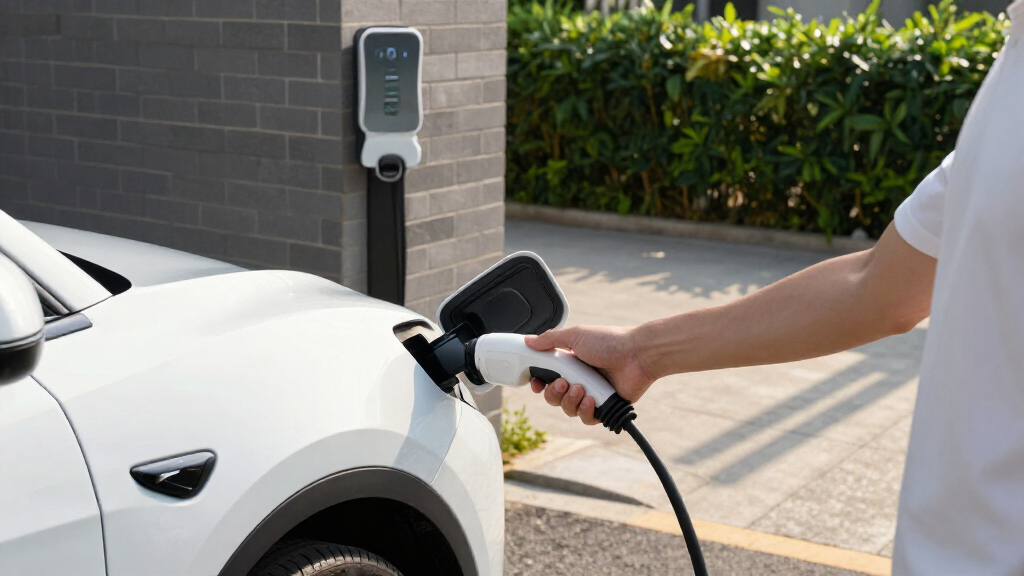

The best EV charging equipment for most home buyers is the Emporia Level 2 48A hardwired charger, which pairs high-output charging with a mature app and load-management features that cheaper units simply don’t offer. If you want plug-in convenience instead of hardwiring, the EVIQO Level 2 40A with NEMA 14-50 plug delivers nearly the same charging speed with a simpler install, while the ChargePoint Home Flex remains the pick for buyers who value app polish and network reliability over raw value. The main tradeoff in this category comes down to amperage versus installation complexity: 48A–50A hardwired units charge fastest but require an electrician, while 40A plug-in models trade a little speed for flexibility and portability. Cable length, connector type (J1772 versus NACS), and whether the app actually works well are what separate great units from frustrating ones. Read on for the full breakdown of all 15 options and which one fits your garage, your car, and your budget.

Get business pricing on monitors, keyboards and dev gear
- Business-only prices and quantity discounts
- Tax-exempt purchasing
- Multiple users, one account, clear invoices
Key Takeaways
- Hardwired 48A–50A units (Emporia, DEWALT, Autel) charge roughly 20% faster than 40A plug-in models, but only pay off if your car’s onboard charger can actually accept 11.5 kW — many EVs cap at 9.6 or 10.9 kW.
- Wi-Fi app quality was the biggest differentiator between similarly priced chargers: units like Emporia and Autel offer scheduling and energy tracking that work reliably, while budget 40A models with generic apps felt like an afterthought.
- Plug-in NEMA 14-50 chargers (EVIQO, Lectron Nexus, AIMILER) are the best fit for renters and anyone who might move, since they unplug and travel with you — hardwired units are permanently tied to the home.
- Only one pick in this lineup (EVIQO NACS) comes with a native Tesla-style connector; every other unit is J1772, so Tesla owners should factor in the cost and slight inconvenience of an adapter.
- The eTimxon 16A portable is the outlier here — it’s a backup or trunk charger, not a primary home unit, and treating it as your main charger is the most common mistake low-budget buyers make.



| EV charging equipment | Connector | Cable Length | Warranty | Certifications |
|---|---|---|---|---|
| EVIQO Level 2 EV Charger | J1772 | 25 ft | 3 years | UL, ETL, FCC, Energy Star |
| AIMILER Level 2 EV Charger | J1772 | 25 ft | — | ETL, FCC |
| MACH 3 Fast 40 Amp Level 1 & 2 | SAE J1772 with NACS/Tesla adapter | 25 ft | 5 years | — |
| Emporia Level 2 EV Charger | SAE J1772 | 25 ft | — | UL listed, ENERGY STAR |
| DEWALT Electric Vehicle Level | SAE J1772 | 25 ft (UL-certified) | 3-year limited | — |
| ChargePoint Home Flex Level 2 | J1772 | — | — | — |
| EVIQO Level 2 NACS EV Charger | NACS | 25 ft | 3 years | — |
| Lectron Nexus Level 2 J1772 EV | J1772 | 23 ft | 3-year limited | UL 2594, UL 2231, ETL, Energy Star, FCC |
| NexCyber Level 2 EV Charger wi | J1772 | 25 ft | 3 years | ETL, FCC (UL2231, UL2594 standards) |
| Emporia Pro Level 2 EV Charger | J1772 | 25 ft | — | Energy Star, NEMA, UL |
| IYILO Level 2 EV Charger | SAE J1772 | 25 ft | 3 years | ETL, Energy Star, CSA |
| 40A Level 2 J1772 EV Charger w | J1772 | 25 ft | 3-year care | ETL to UL-2594, CSA-C22.2 No. 280 |
| Autel MaxiCharger AC Home Leve | J1772 | 25 ft | 3 years | — |
| Autel MaxiCharger AC Home Leve | — | 25 ft | 3 years | — |
| eTimxon 16A Portable Level 1 & | SAE J1772 | — | — | ETL, CE, FCC |
More Details on Our Top Picks
EVIQO Level 2 EV Charger, J1772, 40A, NEMA 14-50, 240V
This option stands out for balancing smart features, weatherproofing, and plug-in simplicity in one package. Compared with the AIMILER, it adds UL and Energy Star certifications plus a NEMA 4/IP66 housing, which matters if you’re mounting outdoors where rain and dust are real concerns. The 25-foot cable is generous enough for driveway parking, and the app’s off-peak scheduling can cut charging costs without any effort on your part. The tradeoff versus the Emporia is raw speed: 40A caps you around 9.6 kW, while the Emporia and DEWALT push 48A. But those units need hardwiring by an electrician, whereas this plugs into an existing NEMA 14-50 outlet. This pick makes the most sense for buyers who want a near-permanent smart station without the installation cost.
Pros:- UL and Energy Star certified with an IP66/NEMA 4 weatherproof housing for outdoor mounting
- 25-foot cable reaches across driveways and garages easily
- App provides remote control, energy tracking, and off-peak scheduling
- Simple plug-in setup on an existing NEMA 14-50 outlet
Cons:- Requires a dedicated 50A circuit and NEMA 14-50 outlet, which not every garage has
- App only connects over 2.4 GHz WiFi, which can frustrate owners of dual-band routers
Best for: Homeowners with an existing NEMA 14-50 outlet who want app scheduling and energy tracking without paying an electrician
Not ideal for: Drivers with long daily commutes who need maximum overnight range recovery — 40A is slower than 48A hardwired units
- Connector:J1772
- Max Amperage:40A
- Voltage:240V
- Outlet:NEMA 14-50
- Cable Length:25 ft
- Certifications:UL, ETL, FCC, Energy Star
- WiFi:2.4 GHz
- Warranty:3 years
Our verdict“The strongest all-around choice for most homes: smart, safe, weatherproof, and ready to plug in on day one.”
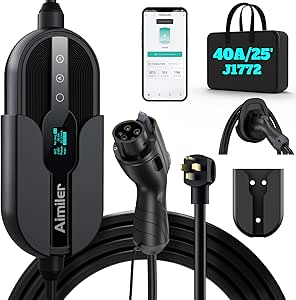
AIMILER Level 2 EV Charger, 40A, 25 ft Cable, Wi-Fi App, J1772 Connector
Where the EVIQO emphasizes certifications and premium housing, this model focuses on the features that actually change daily behavior: adjustable 16–40A current, an onboard LED screen, and app-based scheduling. The adjustable amperage is the standout value play — you can dial down to 16A on an older circuit or share capacity with other appliances, something the fixed-output EVIQO can’t match. Compared with the MACH 3, you give up the included Tesla/NACS adapter and Level 1 flexibility, so this is a stricter single-purpose unit. The on-device screen is a real convenience over app-only rivals, letting you check status at a glance without unlocking your phone. The tradeoff is certification breadth: ETL and FCC listings are solid, but there’s no UL or Energy Star badge here.
Pros:- Adjustable 16–40A current adds flexibility for older wiring or shared circuits
- LED screen shows charging status without opening the app
- Wi-Fi app supports scheduling and charging history
- 25-foot cable matches pricier competitors’ reach
Cons:- No NACS/Tesla adapter included, unlike the MACH 3
- No Level 1 (120V) mode, so it can’t double as a backup trickle charger
- Initial Wi-Fi setup requires a 2.4 GHz connection
Best for: Budget-conscious EV owners who want adjustable amperage and app scheduling at a lower commitment level
Not ideal for: Tesla or NACS-port drivers — the adapter costs extra and adds a failure point at the connector
- Connector:J1772
- Current:Adjustable 16–40A
- Input Voltage:220–240V
- Max Power:9.6 kW
- Cable Length:25 ft
- Plug Type:NEMA 14-50P
- Certifications:ETL, FCC
- Connectivity:Wi-Fi app, LED screen
Our verdict“A sensible budget pick that trades certification prestige for genuinely useful adjustability and an onboard display.”
MACH 3 Fast 40 Amp Level 1 & 2 Portable EV Charger with 25ft Cable
This model earns its spot through broad compatibility and flexibility rather than raw power. Unlike the EVIQO or AIMILER, it includes a NACS/Tesla adapter in the box, so a household with, say, a Tesla and a Hyundai can share one charger without buying extras. It also covers both voltage levels: full 40A on 240V, or a trickle 1.44 kW on a standard 120V household outlet — handy when visiting relatives or stuck without a dryer-style outlet. The five-year warranty outlasts the EVIQO’s three years, which signals confidence in build quality. The obvious tradeoff: Level 1 speed is nearly unusable for daily driving, adding only a few miles of range per hour, and the app leans on Bluetooth plus Wi-Fi, which adds setup steps compared with simpler units.
Pros:- Includes NACS/Tesla adapter, covering essentially every US EV
- Dual Level 1/Level 2 operation works anywhere there’s an outlet
- Five-year warranty is the longest in this batch
- Plug-and-play NEMA 14-50 setup with no electrician required
Cons:- Level 1 charging at 1.44 kW is extremely slow for daily use
- Full 40A speed still requires an existing NEMA 14-50 outlet
- Dual Bluetooth/Wi-Fi connectivity adds setup complexity over simpler chargers
Best for: First-time EV owners and mixed households with both J1772 and Tesla/NACS vehicles
Not ideal for: Anyone hoping to rely on 120V charging — at 1.44 kW it’s an emergency fallback, not a routine option
- Max Current:40 Amps
- Max Power:9.6 kW (240V), 1.44 kW (120V)
- Voltage:120–240V
- Plug Types:NEMA 14-50, NEMA 5-15 adapter
- Connector:SAE J1772 with NACS/Tesla adapter
- Cable Length:25 ft
- Display:2.4-inch LED
- Connectivity:Bluetooth, Wi-Fi
- Warranty:5 years
Our verdict“The most forgiving choice for new EV households that want one charger to work with every vehicle and outlet they might encounter.”
Emporia Level 2 EV Charger, 48A, 240V, Wi-Fi, J1772 Connector, 25 ft Cable, Hardwired, White
For buyers whose priority is recovering range as fast as possible overnight, this hardwired 48A unit delivers up to 46 miles of range per hour — roughly 20 percent quicker than the 40A EVIQO or AIMILER. That gap matters if you drive long distances daily or own a vehicle with a very large battery. The UL listing and Energy Star certification put it in the same safety tier as the EVIQO, and its Wi-Fi platform handles energy monitoring and scheduled charging well. The catch is installation: hardwiring means an electrician, a permanent mount, and no ability to take the charger to a new home or on a road trip, unlike the portable MACH 3. It also lacks a NACS adapter, so Tesla owners need to budget for one. This pick makes the most sense for settled owners planning a permanent home-charging setup.
Pros:- 48A output delivers up to 46 miles of range per hour, the fastest tier in this batch
- UL listed and Energy Star certified
- Wi-Fi energy monitoring and scheduled charging help manage utility costs
- 25-foot cable suits spacious garages and side-yard installations
Cons:- Hardwired installation requires an electrician and permanent mounting
- No NACS/Tesla adapter, adding cost for Tesla owners
Best for: Long-commute drivers and large-battery EV owners who can commit to a professionally installed permanent charger
Not ideal for: Renters or anyone planning a move — hardwiring makes this unit effectively non-portable
- Max Current:48A
- Voltage:240V
- Connector:SAE J1772
- Cable Length:25 ft
- Charging Speed:Up to 46 miles per hour
- Connectivity:2.4 GHz Wi-Fi
- Installation:Hardwired with whip
- Certifications:UL listed, ENERGY STAR
Our verdict“The speed king for permanent home installations — buy it if your battery is big and your commute is long.”
DEWALT Electric Vehicle Level 2 EV Charger, 48 Amps / 240V, App Control, Hardwired Wall-Mounted
This model matches the Emporia’s 48A / 46-miles-per-hour output but layers on features the Emporia skips: an LCD screen for at-a-glance status, adjustable 12–48A current, dual Bluetooth/Wi-Fi app control, and a NEMA 4X/IP66 enclosure built for harsh outdoor exposure. The adjustable amperage is the real premium differentiator — like the AIMILER but at a higher power ceiling, it lets you right-size charging to your panel capacity or solar production. Built in the USA under the DEWALT tool brand, it also carries robust overcurrent, overheating, and surge protections. The tradeoffs mirror the Emporia’s: hardwiring means an electrician visit and zero portability, and Tesla drivers need a separately purchased adapter. If you want the most configurable permanent installation in this lineup, this is the one to beat.
Pros:- Adjustable 12–48A output lets you match panel capacity or solar production
- LCD screen plus Bluetooth/Wi-Fi app for monitoring without opening your phone
- NEMA 4X/IP66 weatherproofing suits exposed outdoor mounting
- Comprehensive overcurrent, overheating, overvoltage, and surge protections
Cons:- Hardwired installation typically requires an electrician
- Tesla/NACS vehicles need an adapter sold separately
- Premium feature set carries a higher total cost once installation is included
Best for: Owners who want a feature-loaded, permanently installed charger with fine-grained amperage control and a display
Not ideal for: Anyone on a tight budget or without an electrician lined up — installation costs stack on top of the premium hardware
- Max Current:48 Amps (adjustable 12–48A)
- Voltage:240V
- Max Power:11.5 kW
- Charging Speed:Up to 46 miles of range per hour
- Cable Length:25 ft (UL-certified)
- Connector:SAE J1772
- Connectivity:Bluetooth & Wi-Fi
- Certification:CSA Certified
- Warranty:3-year limited
Our verdict“The most configurable hardwired charger here — ideal for owners who want display feedback and amperage flexibility for years to come.”
ChargePoint Home Flex Level 2 EV Charger (J1772, NEMA 14-50 Plug)
This option stands out for software maturity rather than raw hardware — the ChargePoint app is arguably the most polished in the category, with scheduling, reminders, smart home integration, and the same account you’d use at 274k+ public ChargePoint stations. Compared with the EVIQO NACS charger, which offers capable scheduling but a younger app, the Home Flex feels like a finished product on the software side. Charging speed is on par with the best here: up to 45 miles of range per hour on a 50A circuit, slightly ahead of the 40A Lectron Nexus and NexCyber units. The tradeoff is that you’re paying a premium for the brand and ecosystem, the UL certification is backed by a 23-foot (not 25-foot) cable, and Tesla drivers need an adapter. This pick makes the most sense for buyers who want their home charger and public charging life in one app.
Pros:- Charges up to 45 miles of range per hour on a 40A or 50A circuit
- Best-in-class app with scheduling, reminders, and smart home integration
- UL certified with a cold-resistant cable rated for indoor or outdoor mounting
- Single account works across home charging and a large public station network
Cons:- Premium price for the hardware specs compared with 40A rivals like the Lectron Nexus
- Requires a NEMA 14-50 outlet on a dedicated 40A or 50A circuit, ideally installed by an electrician
- Tesla vehicles need a separate adapter
Best for: EV owners who already use or plan to use the ChargePoint public network and want the most refined app experience at home
Not ideal for: Tesla owners who want native NACS plug compatibility without an adapter — the EVIQO NACS charger fits better
- Connector:J1772
- Plug:NEMA 14-50
- Amperage:50A (40A or 50A circuit)
- Charging Speed:Up to 45 miles of range per hour
- Installation:Indoor or outdoor
- Certification:UL certified
- Weight:13.8 pounds
Our verdict“Buy this if app quality and ecosystem integration matter as much as charging speed; skip it if you want the lowest cost per amp or native Tesla charging.”
EVIQO Level 2 NACS EV Charger, 40A, NEMA 14-50 Plug
Of the five chargers in this group, this is the only one with a native NACS connector, which makes it the clear choice for Tesla drivers who want to plug in without fumbling for an adapter. Compared with the ChargePoint Home Flex or Lectron Nexus — both J1772 units that force Tesla owners into adapter territory — the EVIQO removes that friction entirely. The 25-foot cable matches the longest here, and the IP66 enclosure handles outdoor mounting in any weather. The app covers scheduling and energy tracking well enough, though it lacks the polish and public-network integration of ChargePoint’s. The real tradeoff runs the other way: J1772 EV owners (Ford, Hyundai, Kia, and most non-Tesla brands) need an adapter that isn’t included, and the glow-in-the-dark holster, while genuinely handy at night, doesn’t offset the absence of a Tesla-to-J1772 solution in the box.
Pros:- Native NACS connector works directly with Tesla vehicles
- 25-foot cable is among the longest in this lineup
- IP66 weatherproof enclosure for indoor or outdoor installation
- App-based scheduling and energy tracking plus glow-in-the-dark holster
Cons:- NACS-to-J1772 adapter for non-Tesla vehicles is not included
- Requires a dedicated 50A circuit and NEMA 14-50 outlet
- App features only work on 2.4 GHz WiFi
Best for: Tesla and NACS-native vehicle owners who want plug-and-play home charging with no adapters
Not ideal for: J1772 EV owners — the required adapter isn’t included, so a J1772 unit like the Lectron Nexus is simpler and cheaper
- Connector:NACS
- Max Current:40A
- Plug:NEMA 14-50
- Voltage:240V
- Cable Length:25 ft
- Warranty:3 years
Our verdict“The obvious pick for Tesla households; anyone driving a J1772 vehicle should look at the Lectron or NexCyber instead.”
Lectron Nexus Level 2 J1772 EV Charger, 40A, 240V, 23-Foot Cable, NEMA 14-50 Plug
Where the NexCyber and EVIQO lean heavily on apps and touch screens, the Lectron Nexus bets on the idea that most buyers just want to plug in and charge reliably. At 9.6 kW it matches the 40A output of those rivals, and the certification list is genuinely strong — UL 2594, UL 2231, Energy Star, ETL — which is more paperwork than many budget chargers can show. The 23-foot cable is three feet shorter than the EVIQO’s and NexCyber’s 25-footers, which matters if your parking spot is deep in a driveway, but it still out-reaches the ChargePoint. The tradeoff is no WiFi, no app, no scheduling — if your utility charges time-of-use rates, you’ll be setting charge timers on the car itself rather than the charger. That simplicity is exactly the point, though: fewer connection points means fewer things to troubleshoot at 6 a.m.
Pros:- Full 9.6 kW output at 40A matches pricier smart rivals
- Extensive safety certifications including UL, ETL, and Energy Star
- IP66 rated for indoor or outdoor use with included holder
- Built-in protection against overheating, overcurrent, voltage, and ground faults
Cons:- No WiFi app, scheduling, or usage tracking of any kind
- 23-foot cable is shorter than the 25-foot runs on the EVIQO and NexCyber
- Tesla vehicles require a separately purchased NACS adapter
Best for: Buyers who want a straightforward, well-certified dumb charger and handle scheduling through their vehicle
Not ideal for: Anyone on time-of-use electricity rates who wants the charger itself to manage off-peak scheduling — the NexCyber does that for less fuss
- Connector:J1772
- Current:40A
- Power:9.6 kW
- Plug:NEMA 14-50
- Cable Length:23 ft
- Certifications:UL 2594, UL 2231, ETL, Energy Star, FCC
- Warranty:3-year limited
Our verdict“A dependable, cert-heavy charger for drivers who see apps as a feature to skip, not a reason to buy.”
NexCyber Level 2 EV Charger with WiFi App, 40A NEMA 14-50 Plug, 25ft Cable, ETL Certified, J1772 Connector
This model delivers the smart features buyers actually pay extra for — WiFi scheduling, cost tracking, and a touch screen — at a price point below the ChargePoint Home Flex, while matching the Lectron Nexus on charging muscle. The standout spec is adjustable amperage from 16A to 40A, which lets you dial back charging on an older circuit or when sharing power with other appliances; none of the other plug-in units here offer that flexibility from the charger itself. The 25-foot cable is rated for 10,000+ charge cycles, matching the EVIQO’s length. The compromises are real, though: the unit is not recommended for direct sun or rain exposure, making it the weakest outdoor candidate in this group despite its weather-resistant rivals, and some owners report E-Stop Fault errors that require a reset. Wiring demands of 6-8AWG also mean an electrician for most homes.
Pros:- Adjustable 16A-40A output lets you match older or shared circuits
- WiFi app with scheduling, cost tracking, and charging history
- 25-foot cable rated for 10,000+ charge cycles
- ETL and FCC certified with a 3-year warranty
Cons:- Not recommended for direct sunlight or rain exposure
- Reported E-Stop Fault errors requiring reset procedures
- Requires professional-grade 6-8AWG wiring, ideally installed by an electrician
Best for: Budget-conscious EV owners charging in a garage who want app scheduling and cost tracking without the premium-brand price
Not ideal for: Outdoor driveway installers — the manufacturer advises against direct sun and rain, so the IP66-rated Lectron or EVIQO is safer
- Connector:J1772
- Max Current:40A (adjustable 16A-40A)
- Plug:NEMA 14-50
- Cable Length:25 ft
- Smart Features:WiFi app, touch screen, scheduling, cost tracking
- Certifications:ETL, FCC (UL2231, UL2594 standards)
- Recommended Wiring:8AWG minimum; 6AWG suggested
- Warranty:3 years
Our verdict“The most feature-per-dollar smart charger here, provided it lives in a garage rather than braving the weather.”
Emporia Pro Level 2 EV Charger with PowerSmart – 48A Fast Home Charging Station with J1772 Connector and 25′ Cable
The Emporia Pro solves a problem none of the other four can touch: PowerSmart load balancing. If your electrical panel is close to capacity, this charger monitors your home’s total draw and throttles charging accordingly — meaning you can run a full 48A output without paying for a panel upgrade. The ChargePoint Home Flex and Lectron Nexus simply demand a fat dedicated circuit and hope for the best. The bundled Emporia Vue energy monitor adds whole-home usage visibility, which pairs naturally with the app’s peak-rate avoidance scheduling. Tradeoffs: 48A output only helps if your service can feed it, the unit still needs professional hardwiring or a 14-50 install, and like the ChargePoint and Lectron it’s J1772 only, so Tesla drivers are back to adapters. It’s also the least portable-minded of the group — this is a permanent wall fixture, not something you’d take to a rental property.
Pros:- PowerSmart load balancing avoids costly electrical panel upgrades
- Highest output in this batch at 48A
- Includes the Emporia Vue for real-time whole-home energy monitoring
- Flexible hardwired or NEMA 14-50 installation with US-based support
Cons:- 48A output is wasted without sufficient electrical service to the home
- Professional installation is effectively required
- J1772 only — Tesla owners need an adapter or the EVIQO NACS instead
Best for: Homeowners with limited panel capacity who want maximum charging speed without funding a service upgrade
Not ideal for: Renters or anyone wanting a portable plug-in unit — the Vue integration and hardwiring option make this a permanent installation
- Amperage:48A
- Connector:J1772
- Input Voltage:240V AC
- Cable Length:25 ft
- Installation:Hardwired or NEMA 14-50 plug
- Connectivity:Wi-Fi, Bluetooth
- Included Accessory:Emporia Vue energy monitor
- Certifications:Energy Star, NEMA, UL
Our verdict“The smart choice if your panel is the bottleneck; overkill for households with plenty of spare electrical capacity.”
IYILO Level 2 EV Charger, 40A/9.6kW/240V, NEMA 14-50P, Wi-Fi Smart Charging Station
This option stands out for buyers who want deeper energy management than a basic wallbox. Beyond scheduled charging, the app handles time-of-use rate settings, energy tracking, and RFID access — a feature set that competes with the EVIQO at a similar power level. The 1A-increment current adjustment (6A–40A) gives finer control than most rivals, which matters if your panel is tight, and power sharing lets two units share one circuit for two-EV households. Compared with the simpler 40A J1772 plug-in model below, the tradeoff is complexity: full load-balancing requires an optional Energy Meter, Wi-Fi is 2.4GHz only, and Tesla drivers need a separately purchased NACS adapter.
Pros:- 1A-increment current adjustment from 6A to 40A for tight electrical panels
- Power sharing supports two chargers on a single breaker
- TOU rate scheduling and RFID access for multi-user driveways
- NTC sensor cuts power at 221°F for real overheat protection
Cons:- Dynamic load balancing requires a separately purchased Energy Meter
- 2.4GHz-only Wi-Fi and limited customer service hours
Best for: Two-EV households and rate-savvy owners who want granular amperage control, RFID access, and detailed cost tracking
Not ideal for: Renters or anyone without a 50A circuit — this requires electrician installation and offers no portable flexibility
- Charging Level:Level 2
- Max Current:40A (adjustable 6A–40A)
- Max Power:9.6 kW
- Voltage:240V
- Plug Type:NEMA 14-50P
- Connector:SAE J1772
- Cable Length:25 ft
- Certifications:ETL, Energy Star, CSA
- Warranty:3 years
Our verdict“The pick for homeowners who treat charging as part of a whole-home energy strategy rather than a plug-and-forget appliance.”
40A Level 2 J1772 EV Charger with NEMA 14-50 Plug and 25-Foot Cable
Not everyone wants an app-driven ecosystem. This model earns its spot by offering three access modes — plug-and-charge, RFID, and app — so you can ignore the software entirely and just plug in. Where the IYILO above rewards tinkerers with TOU rates and power sharing, this charger keeps things simple and forgiving: current adjusts through either the screen button or the app, and the IP65 enclosure handles outdoor mounting without worry. The 25-foot cable matches the roundup standard, so reach isn’t a compromise. The tradeoff is fewer smarts — no energy-cost analytics or load balancing — and Tesla owners will need their own adapter.
Pros:- Three access modes including true plug-and-charge operation
- IP65 rating for reliable outdoor installation
- Current adjustable via screen button even without the app
- ETL listed to UL-2594 and CSA standards
Cons:- Tesla compatibility requires a separately purchased adapter
- No energy monitoring or load-balancing capability
Best for: Drivers who want full-speed 9.6 kW home charging without managing an app, especially those already owning a NEMA 14-50 outlet
Not ideal for: Data-driven owners who want per-session cost tracking and load management — the IYILO covers that better
- Connector:J1772
- Max Current:40A (10–40A via app)
- Max Power:9.6 kW
- Plug Type:NEMA 14-50
- Cable Length:25 ft
- Ingress Protection:IP65
- Certifications:ETL to UL-2594, CSA-C22.2 No. 280
- Warranty:3-year care
Our verdict“The right choice if you want a dependable 40A wallbox that works the day it’s mounted and never asks for your attention again.”
Autel MaxiCharger AC Home Level 2 EV Charger, 50A, 240V, Hardwired, 25-Foot Cable
Hardwiring buys you headroom: at 50A and 12 kW, this Autel out-charges every 40A plug-in model in this roundup, including the IYILO and Lectron Nexus. Its real differentiator is triple connectivity — Wi-Fi, Bluetooth, and Ethernet — which matters in garages where wireless signals struggle; no other pick here offers a wired fallback. The NEMA Type 4 enclosure and -40°C rating make it more weatherproof than the IP65 plug-in unit. Compared with Emporia’s 48A hardwired charger, the Ethernet port and rugged enclosure give it an edge for demanding installs. The cost is permanence: it needs an electrician, and moving it to a new home means rewiring.
Pros:- 12 kW output outpaces every 40A charger in the lineup
- Ethernet plus Wi-Fi and Bluetooth for reliable connectivity anywhere
- NEMA Type 4 enclosure rated to -40°C for severe weather
- Remote firmware updates keep features current
Cons:- Requires professional hardwired installation
- J1772 connector needs an adapter for NACS vehicles
Best for: Owners in large garages, weak-Wi-Fi homes, or harsh climates who want maximum charging speed and a wired connection option
Not ideal for: Renters and anyone who might relocate — hardwired installation means this stays with the house
- Max Current:50A
- Max Power:12 kW
- Voltage:240V
- Connector:J1772
- Cable Length:25 ft
- Installation:Hardwired
- Connectivity:Wi-Fi, Bluetooth, Ethernet
- Operating Temperature:Down to -40°C
- Warranty:3 years
Our verdict“A spend-up choice for permanence-minded owners who want the fastest, most connected, most weatherproof unit here.”
Autel MaxiCharger AC Home Level 2 EV Charger, 50A, 240V, Hardwired, 25-Foot Cable
This is the sibling of the Autel above with one capability that changes who it’s for: amperage adjusts from 6A to 50A. That wide range makes it unusually flexible — dial it down for an older panel, or up when a second car arrives. While the Ethernet-equipped MaxiCharger suits connectivity-focused buyers, this model makes more sense for households with mixed electrical capacity or an EV plus a plug-in hybrid with a smaller onboard charger, where 50A is wasted but 16A is too slow. It shares the same NEMA 4 weather protection and -40°C tolerance, so northern-climate installs are covered. The same hardwiring requirement applies, so budget for an electrician either way.
Pros:- Adjustable 6–50A output spans every realistic home charging scenario
- 12 kW ceiling future-proofs for faster onboard chargers
- NEMA 4 enclosure with -40°C operation for outdoor northern installs
- App-based charge management and scheduling
Cons:- Hardwired installation adds cost and prevents relocation
- No Ethernet option unlike the higher-trim Autel MaxiCharger
Best for: Families with one older or limited electrical panel who want the flexibility to charge anywhere from 6A to 50A without changing hardware
Not ideal for: Anyone wanting plug-in convenience or portability — this is a fixed, electrician-installed unit
- Max Amperage:50A (adjustable 6–50A)
- Max Power:12 kW
- Voltage:240V
- Cable Length:25 ft
- Installation:Hardwired
- Operating Temperature:Down to -40°C
- Weight:16.72 lb
- Warranty:3 years
Our verdict“The flexible-amperage hardwired pick for households whose electrical situation — or EV fleet — might change over time.”
eTimxon 16A Portable Level 1 & 2 EV Charger – ETL Certified, 110V-240V, J1772
Every fixed wallbox in this roundup — from the IYILO to both Autels — assumes a permanent install. The eTimxon answers a different question: what do you keep in the trunk? Its dual-level design means one unit covers a 240V NEMA 6-20 outlet at 3.84 kW and a standard 120V household plug at 1.44 kW, which makes it roughly 4x faster than a basic Level 1 cord when you find a 240V outlet at a relative’s house or a job site. Compared with the MACH 3 portable, it trades raw speed for genuine two-plug versatility and smart over-temperature protection that throttles rather than trips. The honest tradeoff: 16A means an 87kWh pack still takes over 22 hours, so this is a supplement, not a primary charger.
Pros:- Dual NEMA 6-20 and 5-15 plugs cover both 240V and 120V outlets
- Over-temperature protection throttles power and auto-resumes instead of failing
- ETL, CE, and FCC certified for safe use across outlet types
- Compact form factor suits trunk storage
Cons:- Requires a dedicated 6-20 outlet for Level 2 speeds
- Over 22 hours to charge an 87kWh battery even in Level 2 mode
Best for: EV owners who want a trunk charger for travel, visiting family, or as emergency backup alongside a home wallbox
Not ideal for: Anyone relying on it as their only charger — long-range EVs with large batteries will find even its Level 2 mode painfully slow
- Max Current:16A
- Max Power:3.84 kW (Level 2)
- Level 2 Mode:240V, 16A, NEMA 6-20 plug
- Level 1 Mode:120V, 12A, 1.44 kW (NEMA 5-15 adapter)
- Connector:SAE J1772
- Certifications:ETL, CE, FCC
Our verdict“A smart trunk companion for opportunistic charging on the road, not a substitute for a proper 40A home station.”
How We Picked
I evaluated each charger against the factors that actually shape daily ownership: charging speed relative to what most EVs can accept, installation requirements (plug-in versus hardwired), cable length and manageability, smart features and app reliability, and certification and build quality. A 25-foot cable scores higher than shorter ones because it reaches across driveways and around garage corners, and units with adjustable amperage rank higher for buyers on older electrical panels. Where two chargers matched on hardware, the maturity of the app ecosystem and energy-tracking features broke the tie.
The ranking order reflects a simple philosophy: buyers are best served by chargers that match their electrical panel and their car’s onboard charging limits, not just the highest amperage number. Premium hardwired units sit at the top for whole-home integration and speed, versatile 40A plug-in models fill the middle because they fit the widest range of situations, and the budget and portable units round out the list for specific use cases rather than general ownership.
| EV charging equipment | Connector |
|---|---|
| EVIQO Level 2 EV Charger | J1772 |
| AIMILER Level 2 EV Charger | J1772 |
| MACH 3 Fast 40 Amp Level 1 & 2 | SAE J1772 with NACS/Tesla adapter |
| Emporia Level 2 EV Charger | SAE J1772 |
| DEWALT Electric Vehicle Level | SAE J1772 |
| ChargePoint Home Flex Level 2 | J1772 |
| EVIQO Level 2 NACS EV Charger | NACS |
| Lectron Nexus Level 2 J1772 EV | J1772 |
| NexCyber Level 2 EV Charger wi | J1772 |
| Emporia Pro Level 2 EV Charger | J1772 |
| IYILO Level 2 EV Charger | SAE J1772 |
| 40A Level 2 J1772 EV Charger w | J1772 |
| Autel MaxiCharger AC Home Leve | J1772 |
| Autel MaxiCharger AC Home Leve | — |
| eTimxon 16A Portable Level 1 & | SAE J1772 |
Factors to Consider When Choosing Best EV Charging Equipment
Before choosing a charger, it helps to understand how the category works — because the most expensive unit isn’t automatically the right one, and a mid-priced charger that matches your panel and your car will outperform a premium unit that doesn’t.Match the Charger to Your Car’s Onboard Limit
The most common overspend in this category is buying a 48A or 50A charger for a car that can only accept 9.6 kW. Your EV has a built-in onboard charger that caps how fast it can take AC power, and no wall unit can exceed it. If your vehicle maxes out at 40 amps of acceptance, a 50-amp Autel or 48-amp Emporia charges no faster than a well-built 40-amp model — you’ve paid a premium and paid an electrician for hardwiring for zero benefit. Check your car’s spec sheet for its maximum AC charge rate before you buy anything. The exception: if you plan to keep the charger through your next car, buying headroom now can make sense, since newer EVs increasingly support the full 11.5 kW.
Plug-In Versus Hardwired — and What Your Panel Allows
A NEMA 14-50 plug-in charger installs in minutes if you already have a 50-amp outlet (common in garages built for welders or RVs), and it moves with you when you change homes. Hardwired units require an electrician, but they allow higher sustained amperage, avoid plug-related fire concerns that some insurers and local codes flag, and are required for the 48A and 50A models in this lineup. One mistake I see repeatedly: buyers with 100-amp service panels assuming they can add a 50-amp circuit without checking capacity. If your panel is tight, look at chargers with adjustable amperage down to 24A or lower, or consider the Emporia Pro’s power-management capability, which can share capacity with other home loads instead of tripping your main breaker.
Connector Type: J1772, NACS, and the Adapter Question
Nearly every charger here uses J1772, the long-standing North American standard, which works with all non-Tesla EVs natively. Tesla and some newest-generation vehicles use the NACS connector, and the industry is mid-migration — most NACS-equipped cars still ship with a J1772 adapter. If you drive a Tesla, a J1772 charger plus adapter works fine but adds a small daily friction point; a native NACS unit like the EVIQO NACS model eliminates it. If you own multiple vehicles from different brands, J1772 plus adapters on each car is the more flexible arrangement. My suggestion: buy for the car you own today, not the one you might own in five years, unless the adapter situation is genuinely painful for your household.
Smart Features Worth Paying For (and Ones That Aren’t)
Scheduling, energy monitoring, and demand-response program compatibility are the smart features that genuinely save money — charging overnight on time-of-use rates can cut your fueling cost dramatically. App quality varies more than hardware quality in this category, and a clunky app turns scheduling into a chore you abandon. Connectivity matters too: Wi-Fi-only units lose features if your router is far from the garage, so check your signal strength before committing. Features like voice assistant integration and multi-user access are nice but rarely justify paying more. If you’re on a budget, a dumb charger on a cheap outlet timer captures most of the scheduling benefit at a fraction of the cost.
Cable Length and Physical Placement
Cable length is the spec buyers regret underestimating. A 25-foot cable comfortably reaches a car parked nose-in on either side of a two-car garage; shorter cables force awkward parking or repositioning. Measure the distance from your mounting point to the charge port on your car in its worst-case parking position, then add several feet of slack — cables never route in a straight line. Also consider where the port sits on your vehicle: port location varies wildly between models, and a rear-passenger-side port changes your mounting math entirely. Outdoor installations additionally need a properly rated enclosure and a holster, which some budget chargers omit from the box.
Certification, Warranty, and the Budget Trap
Insist on ETL or UL certification — an uncertified charger can void your EV’s battery warranty and may violate local code, and several no-name listings skip this entirely. Warranty length is a reasonable proxy for build confidence: the established brands here back their units for three years or more, while generic units often carry one-year coverage with slow support. The budget trap in this category is the 16A portable charger marketed as a home solution — at 3.8 kW it adds barely 12–15 miles of range per hour, which is fine for plug-in hybrids but painful for a full battery EV. Spend for a real 40A unit if this is your primary charger; reserve portables for emergencies and travel.
Frequently Asked Questions
Is a 48A or 50A charger actually worth it over a 40A model?
Only if your car can accept the extra power. A 40A charger delivers 9.6 kW, which adds roughly 25–30 miles of range per hour on most EVs; a 48A unit delivers 11.5 kW, or around 30–35 miles per hour. That difference matters if you routinely deplete a large battery overnight and need full recovery between late-evening sessions, but for typical daily driving of 40–60 miles, both sizes finish well before morning. The 48A route also demands hardwiring and a 60-amp circuit, which raises installation cost. If your panel already supports it and your car accepts 11.5 kW, the premium pays off; otherwise the 40A plug-in route is the smarter spend.
Can I install a NEMA 14-50 charger myself, or do I need an electrician?
If a properly rated 14-50 outlet already exists in your garage, plugging in a charger is genuinely a DIY job — just confirm the breaker and wiring match the outlet, because miswired RV-style outlets are a known hazard. If no outlet exists, you need an electrician: adding a 50-amp 240V circuit involves panel capacity calculations, conduit or cable runs, and permitting. Doing that work unpermitted can create problems with insurance claims and home sales later. Budget for the electrician in your total cost, because installation often costs as much as or more than the charger itself, and that reality should shape which tier of charger you buy.
Do I need a Wi-Fi-connected charger, or is a basic unit fine?
It depends entirely on your electricity rate structure. If your utility charges time-of-use rates, smart scheduling can cut your charging cost by 30–50% by restricting charging to off-peak windows, and energy monitoring helps you verify the savings. If you pay a flat rate per kilowatt-hour, a basic charger loses almost nothing — you can mimic scheduling with a dumb timer if needed. The middle ground is reliability: a smart charger with a bad app is worse than a dumb charger, because features that fail become frustration. Read the app situation carefully for budget brands before assuming the smart features will work as advertised.
What’s the right charger if I drive a Tesla?
Teslas charge happily from any J1772 charger using the adapter that ships with the car, so every unit in this lineup technically works. The daily friction is small but real: you attach the adapter every session and risk leaving it at home. If you want a cleaner setup, the native NACS option here — the EVIQO NACS model — plugs straight in with no adapter. Tesla owners who want maximum ecosystem integration might also consider Tesla’s own Wall Connector, though it wasn’t part of this comparison. For most Tesla households, a well-priced J1772 charger plus adapter is perfectly livable, and it future-proofs you if a second non-Tesla EV joins the garage.
Should I buy a portable charger as my only home charger?
Generally no, unless you drive a plug-in hybrid with a small battery. Portables like the 16A eTimxon max out around 3.8 kW — roughly 12–15 miles of range per hour — which means a depleted long-range EV needs well over a full day to recover. That’s workable for overnight top-ups of modest daily driving, but one long road-trip day leaves you playing catch-up for days. A true Level 2 wall unit at 40A restores a full battery overnight without thinking about it. Where portables earn their keep is as a trunk-mounted backup for travel, visits to homes without charging, and emergency use — a role worth filling after your primary charger is sorted, not instead of one.
Conclusion
For best overall, the Emporia Level 2 48A hardwired charger earns the top spot with fast charging, a genuinely useful app, and energy management that grows with a smart home. The DEWALT 48A and Autel MaxiCharger 50A sit right behind it for buyers who want maximum hardwired output with rugged build quality. For best value, the EVIQO 40A plug-in and Lectron Nexus deliver nearly the real-world charging speed of the premium units at a lower total cost of ownership, since no electrician is required if you have an existing 14-50 outlet. For best premium setup, the Emporia Pro with PowerSmart is the pick for homeowners managing total panel load or integrating solar. For beginners and renters, plug-in 40A models like the AIMILER or the generic ETL-certified 40A unit offer low-risk entry points with smart features. And for specific needs: the EVIQO NACS for Tesla owners wanting a native connector, the MACH 3 for a dual Level 1/Level 2 travel unit, and the eTimxon 16A strictly as a trunk backup. Match the charger to your car’s charging limit and your panel’s capacity, and the right pick from this list becomes obvious.
Halloween Picks
halloween
As an affiliate, we earn on qualifying purchases.