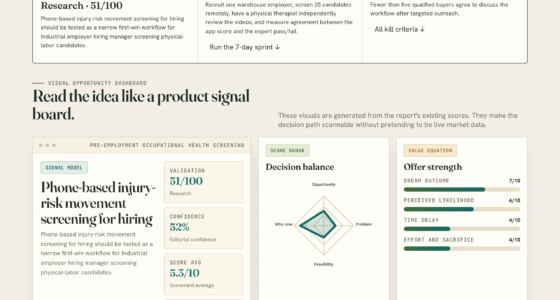

📊 Full opportunity report: From Data To Decision: AI Local Document Pipelines Made Easy on ThorstenMeyerAI.com — validation score, market gap, and execution plan.
TL;DR
A new reference architecture for local AI document pipelines has been introduced, emphasizing simplicity, modularity, and data security. It enables organizations to process documents entirely on-premises, improving control and compliance.
Documents in. Typed rows out.
Nothing leaves the building.
The reference architecture this week was pointing at: a hash, a Postgres queue, two model passes, a review loop, provenance columns — boring architecture around rapidly-improving models. Commands live in the companion repo; the design lives here.
Five stages, one spine
Idempotent by content hash: reprocessing is always safe, “did we do this file?” is a primary-key lookup. Two model passes on purpose — transcription errors and extraction errors have different fixes.
The four principles everything hangs on
Exceptions are the product
Confidence routing
Low-confidence fields, schema failures, unparseable pages → human_review jobs in the same queue. Corrections stored as data — your ground-truth set for the next model swap builds itself.
Field observations
Exception rate is dominated by input quality, not model quality — a scanner upgrade often beats a model upgrade. And a 93% benchmark means the real design problem is the other 7%.
- Low volume: under ~10–20K pages/month, one week of this engineering costs more than a year of API invoices.
- Prebuilt schemas fit: if your documents are exactly the invoice/receipt/ID categories and DSGVO permits, the cloud prebuilt tier is the honest recommendation.
- Degraded inputs: phone photos and crumpled scans invert the benchmarks (Real5-OmniDocBench). Test on YOUR documents first.
- No owner: a local pipeline is infrastructure. If nobody patches it and watches the dead-letter queue, buy the cloud’s real product — their ops team.
DSGVO: what local removes
The Auftragsverarbeitung surface for processing itself — no vendor DPA, no transfer analysis, no sub-processor audits for the core path.
DSGVO: what remains
GDPR itself. Purpose limitation, retention, deletion, access controls — local processing is still processing. Simplifies compliance; never waives it.
Why This Modular, On-Premises Architecture Matters
This architecture enables organizations to deploy AI document processing entirely within their own infrastructure, enhancing data security, compliance, and control. By keeping models and data local, companies reduce reliance on third-party cloud providers, mitigate data privacy risks, and streamline operations. The design principles focus on maintainability, flexibility, and safety, making AI pipelines accessible even for teams with limited ML expertise. As AI models become more capable and complex, this approach ensures that organizations can adapt quickly, swap models easily, and maintain consistent, auditable workflows, which is especially vital in regulated sectors like finance, healthcare, and legal services.on-premises OCR document processing software
As an affiliate, we earn on qualifying purchases.
As an affiliate, we earn on qualifying purchases.
Emergence of Local AI Pipelines and Industry Trends
Recent developments have seen a shift toward local AI inference and processing, driven by data privacy regulations such as the AI Act and increasing concerns over data governance. Major players like Hugging Face demonstrated the operational necessity of local models, especially as models grow larger and more capable, with some now surpassing 3 billion parameters. These trends highlight a need for standardized, maintainable architectures that can support model updates, ensure data security, and simplify deployment. The architecture presented this week builds on these trends by offering a reference design that balances simplicity with robustness, addressing the challenges posed by rapid model evolution and complex data workflows.“This architecture is a practical blueprint for organizations aiming to run reliable, maintainable, and secure local document pipelines, even as models evolve rapidly.”
— Thorsten Meyer, AI Infrastructure Expert
As an affiliate, we earn on qualifying purchases.
Remaining Questions About Deployment and Scalability
It is not yet clear how well this architecture scales in high-volume enterprise environments or how it handles complex workflows involving multiple model types and data sources. Details on performance benchmarks, real-world deployment experiences, and integration with existing enterprise systems are still emerging.
RIP VAULT End of Life Organization System – Fireproof Storage Box for Important Documents – Estate Planning Tool with Pre-labeled File Organizer Folders | All-in-one Solution – Rated Up to 1200°F
- All-in-One Filing System: Pre-labeled folders and checklists included
- Fireproof Document Box: Rated to withstand up to 1200°F
- Waterproof and Durable: Provides superior protection for documents
As an affiliate, we earn on qualifying purchases.
As an affiliate, we earn on qualifying purchases.
Next Steps for Adoption and Standardization
Organizations are expected to experiment with implementing this architecture in pilot projects, testing its robustness and flexibility. Further development will likely focus on optimizing performance, expanding support for diverse models, and creating tooling to streamline deployment. Industry groups may also work toward establishing standards based on this reference design to promote wider adoption and interoperability.PostgreSQL queue management software
As an affiliate, we earn on qualifying purchases.
As an affiliate, we earn on qualifying purchases.
Key Questions
How does this architecture improve data security?
By processing all documents locally within an organization’s infrastructure, the architecture ensures that sensitive data does not leave the premises, reducing exposure to external threats and complying with data governance regulations.Can this pipeline support different OCR and extraction models?
Yes, the design intentionally decouples components, allowing easy swapping of models via configuration. This flexibility supports experimentation and model upgrades without disrupting the overall pipeline.Is this architecture suitable for high-volume enterprise use?
While designed to be simple and maintainable, scalability in high-volume settings remains an area for further testing. Performance benchmarks and deployment case studies are expected to develop over time.What are the main benefits over cloud-based pipelines?
The primary benefits include improved data privacy, compliance with regulations, reduced dependency on external providers, and greater control over model updates and workflows.How does this architecture handle model updates?
Model swaps are designed to be a configuration change, allowing seamless updates without altering the core pipeline, supporting rapid iteration and model experimentation.Source: ThorstenMeyerAI.com