
📊 Full opportunity report: How Parents Use Simulators To Rehearse Tough IEP Negotiations on IdeaNavigator AI — validation score, market gap, and execution plan.

Get business pricing on monitors, keyboards and dev gear
- Business-only prices and quantity discounts
- Tax-exempt purchasing
- Multiple users, one account, clear invoices
TL;DR
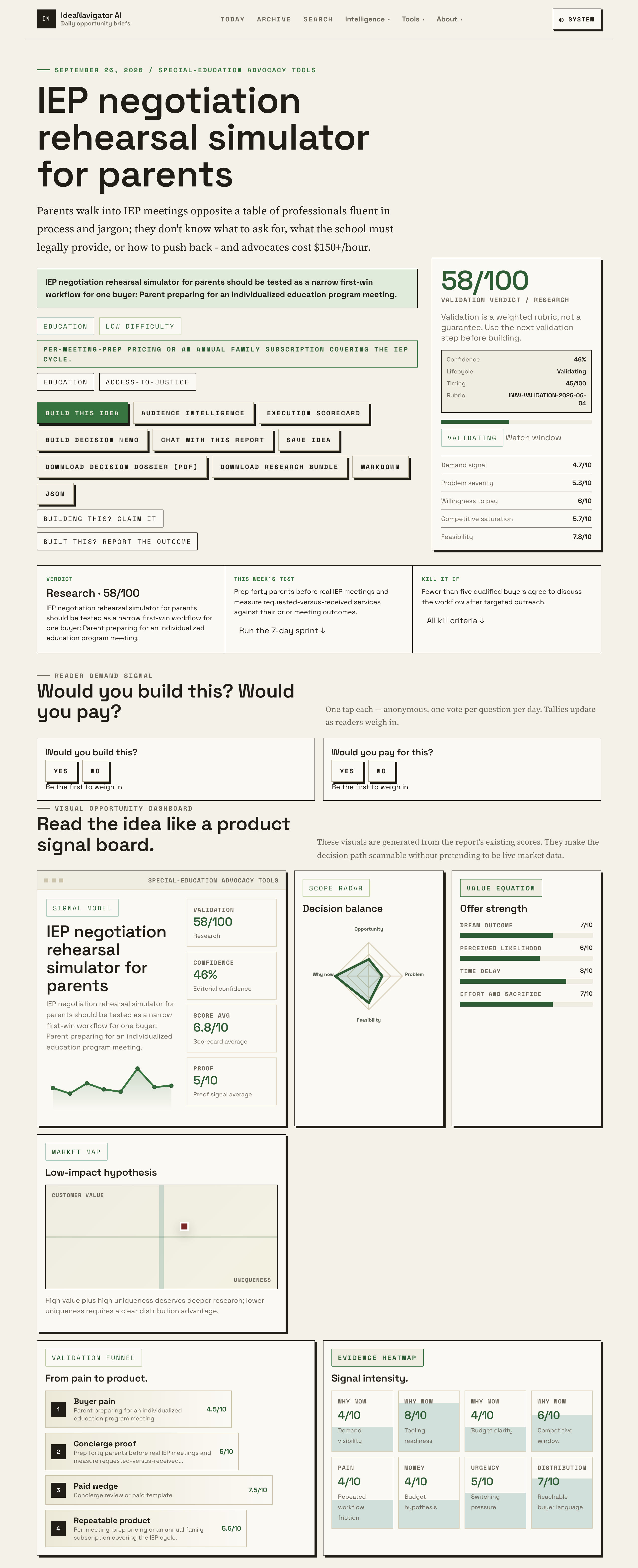
IdeaNavigator AI has outlined a proposed simulator that would help parents prepare for individualized education program meetings through document review and role-play. The idea has not been shown to improve meeting outcomes; its proposed first test is preparation for 40 parents before real meetings.
IdeaNavigator AI has proposed a simulator to help parents prepare for individualized education program (IEP) meetings by reviewing school documents, explaining possible entitlements and rehearsing conversations with school staff. The proposal describes a product concept and a test with 40 parents; it provides no evidence yet that the tool has been built or improves services students receive.
The proposed tool is aimed at a parent preparing for an IEP meeting. Its suggested first version would let a parent upload a current IEP and evaluation reports, then receive plain-language explanations, a list of requests to consider with legal grounding, and a simulated meeting with realistic pushback. The goal would be to let parents practice stating and defending their positions before meeting with school personnel.
IdeaNavigator AI frames the problem as an imbalance in familiarity with special education procedures and terminology: parents may face a group of professionals without knowing what questions to ask or what services to request. It also points to the cost of advocacy, citing rates of $150 or more per hour. The proposal does not specify where that rate applies or provide a supporting survey or other data.
The suggested business models are a fee for preparing for one meeting or an annual family subscription covering an IEP cycle. To evaluate the concept, IdeaNavigator AI proposes preparing 40 parents before actual meetings and comparing requested services with services received, using each family’s prior meeting outcomes as a baseline. No recruitment, study timeline, comparison method or results are reported.
A Test of Meeting Preparation
If developed and shown to work, a rehearsal tool could give parents a way to practice conversations before meetings where educational plans and services are discussed. Plain-language document explanations and simulated questions could help a parent organize concerns and make specific requests. The proposal’s practical importance depends on whether families can use it accurately and whether preparation changes what happens in meetings.
The proposed test focuses on services parents request and receive, compared with their earlier outcomes. That comparison could offer an initial signal, but the proposal does not explain how it would account for differences between students, schools or meetings. Without those details and measured results, claims about effectiveness would be premature.
Top picks for "parent simulator rehearse"
As an affiliate, we earn on qualifying purchases.
From Concept to Pilot
An IEP is a plan developed for a student who qualifies for special education services. Meetings can involve parents and school staff discussing a student’s needs, goals and supports. The proposal centers on helping parents prepare for those conversations; it does not describe a tool for schools or a replacement for a special education advocate.
IdeaNavigator AI argues that language-model role-play may now be realistic enough for this use and says rising identification rates and tighter district resources are making meetings more adversarial. Those are claims in the proposal, which gives no figures, dates or independent evidence to establish the trends or show that meetings are becoming more adversarial. The concept’s next defined step is a 40-parent test, not a reported product launch.
Accuracy and Outcomes Unproven
It is not clear whether a simulator has been built, who would review its legal explanations, or how it would account for differences in state and local rules. The proposal does not identify a launch date, price, data-protection practices, or whether uploaded IEPs and evaluations would be stored or used to improve the system.
It also remains unknown whether role-play would help parents reach their goals, whether schools would respond differently to better-prepared requests, or how the proposed 40-parent comparison would distinguish the tool’s effects from other factors. The cited advocate rate and claims about changing identification rates and district resources are not supported with details in the proposal.
The Proposed 40-Parent Pilot
The next step described by IdeaNavigator AI is to prepare 40 parents for real IEP meetings and compare the services they request and receive with outcomes from their previous meetings. No schedule or recruitment details have been announced. Any assessment would need to report how outcomes were measured and account for the differences between families and meetings.
Until a pilot is completed and its findings are available, the simulator remains a product proposal. Its legal explanations, privacy safeguards, pricing and effect on educational services have yet to be established.
Source: IdeaNavigator AI
Key Questions
What would the proposed IEP simulator do?
It would review an uploaded IEP and evaluation reports, explain information in plain language, suggest requests with legal grounding and let a parent rehearse a meeting through role-play.
Has the simulator been shown to improve IEP outcomes?
No results are provided. IdeaNavigator AI proposes testing the concept with 40 parents before real meetings.
How would the proposed test measure results?
The proposal says it would compare services requested and received with each parent’s outcomes at a prior meeting. It does not provide a detailed study method or timeline.
How might families pay for the tool?
Possible models include a fee for preparation for one meeting or an annual subscription covering an IEP cycle. No prices are stated.
Source: IdeaNavigator AI
Fall Picks
fall essentials
As an affiliate, we earn on qualifying purchases.