

📊 Full opportunity report: Auto Signal Monitor: EU's Driver Monitoring Camera Rule Covers Every New Car on IdeaNavigator AI — validation score, market gap, and execution plan.

Get business pricing on monitors, keyboards and dev gear
- Business-only prices and quantity discounts
- Tax-exempt purchasing
- Multiple users, one account, clear invoices
TL;DR
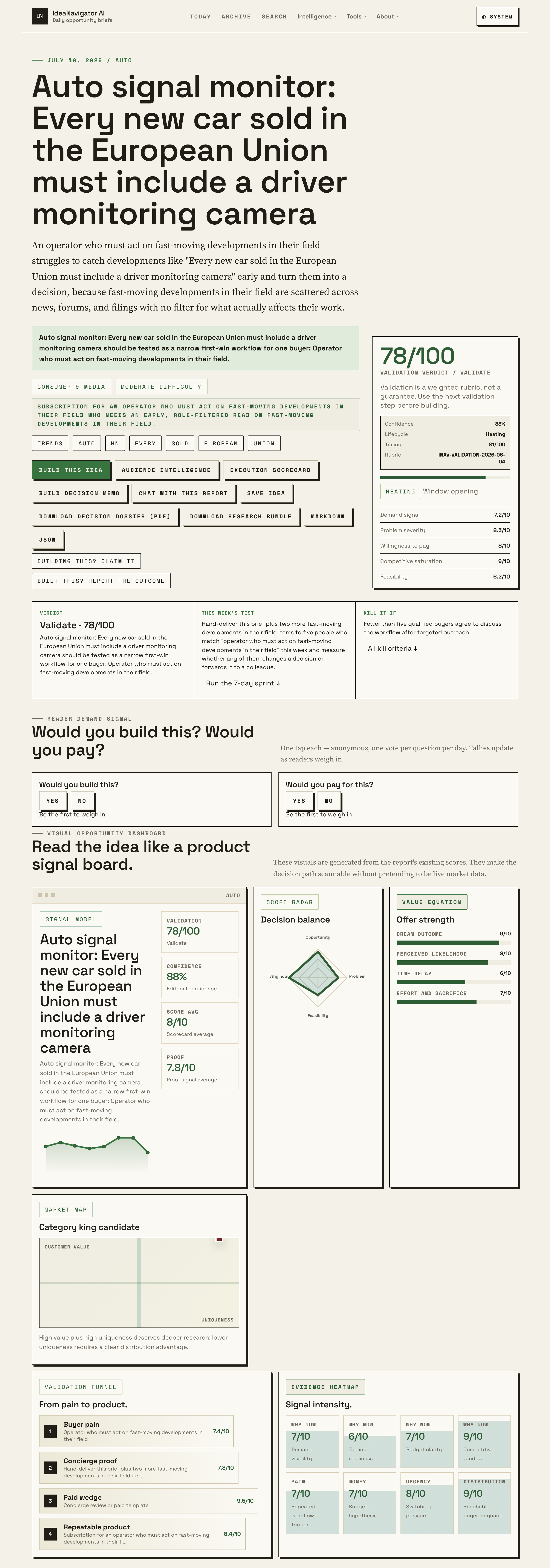
Every new car sold in the European Union is now required to include a driver monitoring system capable of detecting drowsiness and distraction, with most manufacturers implementing the mandate through an inward-facing camera. The requirement, part of the EU’s General Safety Regulation, took effect for all new vehicle registrations on 7 July 2024.
Every new car sold in the European Union must now be fitted with a driver drowsiness and attention warning (DDAW) system, a mandate that in practice means an inward-facing camera watching the driver’s face and eyes for signs of fatigue or distraction. The requirement, part of the EU’s updated General Safety Regulation, applied to all new type-approved vehicle models from July 2022 and, since 7 July 2024, covers every new car registered in the bloc regardless of when its model was first approved.
The rule stems from Regulation (EU) 2019/2144, the General Safety Regulation adopted in late 2019, which introduced a suite of mandatory safety technologies alongside the driver monitoring requirement, including intelligent speed assistance, lane-keeping assistance, emergency stop signalling, and event data recorders. The driver monitoring provision is designed to address fatigue and distraction, which European road safety bodies identify as contributing factors in a substantial share of serious road collisions.
While the regulation sets a performance requirement rather than prescribing a specific technology, most major manufacturers have implemented it with a cabin-facing camera mounted on the steering column or dashboard that tracks eye closure, blink duration, gaze direction, and head position. When the system detects signs of drowsiness or sustained inattention, it issues escalating warnings — typically visual and acoustic alerts — urging the driver to take a break. Camera-based systems have largely displaced steering-input analysis, which earlier drowsiness detection features relied on, as manufacturers cite greater reliability from direct observation of the driver’s eyes in detecting distraction.
Drivers can, in most implementations, temporarily dismiss or reduce the sensitivity of the warnings, but the system itself cannot be permanently disabled, and it activates automatically on every journey. The mandate applies to passenger cars as well as light and heavy commercial vehicles, with the European Commission stating that the combined package of mandatory safety measures is projected to prevent tens of thousands of fatalities and serious injuries across the EU over the coming decades.
What the Camera Mandate Means for Drivers
Anyone buying a new car in the EU — and in several neighbouring countries that align with EU vehicle rules, such as Norway, Switzerland, and the United Kingdom under its retained version of the regulation — will now be driving a vehicle equipped with a cabin camera. Driver organisations and consumer groups have reported that some users find the alerts trigger in situations such as checking mirrors or wearing sunglasses, and the systems cannot be switched off permanently.
The rule also affects the auto industry and its suppliers. Camera-based monitoring has become a growth market for component makers, and the mandate standardises a technology that was previously offered as a premium feature. For fleets and commercial operators, the systems add a compliance dimension, since warnings are logged and, in some configurations, can feed into fleet management reporting.
Privacy has been a frequently raised aspect of the mandate in public discussion. Unlike event data recorders, which store only crash-related data, driver monitoring cameras process biometric information — facial features, eye behaviour — in real time. Manufacturers state that the processing happens locally in the vehicle and that images are not stored or transmitted. Data protection authorities in several member states have said they are examining how these systems handle personal data and how clearly drivers are informed.
How the EU Rule Reached Full Coverage
The General Safety Regulation was adopted in November 2019 as part of the EU’s response to stagnant road fatality figures, with the stated goal of moving from protecting occupants in crashes to preventing crashes from occurring in the first place. The regulation followed a two-stage introduction: new vehicle type approvals had to comply from 6 July 2022, and all newly registered vehicles — including models already on the market — from 7 July 2024. That second deadline is what brought the driver monitoring requirement to every new car sold, not just newly launched models.
The rollout has coincided with a broader industry shift toward cabin sensing. Several manufacturers had already fitted attention-monitoring cameras in higher trims, partly in anticipation of the mandate and partly to support hands-free driving assistance features that require confirmation the driver is watching the road. The EU rule made the technology standard equipment across the market. Interest in the mandate resurfaced in technology and policy discussions in recent weeks, according to a signal brief published by IdeaNavigator AI, which flagged the topic as a recent development for operators tracking automotive and regulatory change.
Open Questions on Privacy and Enforcement
Several points remain unresolved. It is not yet clear how uniformly member states will enforce the performance requirements, since the regulation defines detection capabilities but leaves manufacturers latitude in how warnings are calibrated and how quickly they escalate. Consumer testing organisations have found wide variation in how sensitive different systems are in practice.
Data protection treatment is also still developing. National privacy regulators have not issued binding Europe-wide guidance on driver monitoring data, and it remains to be seen whether future over-the-air software updates could change what the cameras record or transmit — a concern raised by privacy advocates, though manufacturers currently state that no image data leaves the vehicle. Finally, how the systems interact with drivers wearing sunglasses, or with certain medical conditions affecting eye movement, varies by implementation and is documented inconsistently across owner manuals.
Coming Rules and Industry Responses
Attention now shifts to enforcement and refinement. EU type-approval authorities will continue testing whether production systems meet the drowsiness detection performance thresholds, and consumer safety bodies such as Euro NCAP are expected to weigh driver monitoring quality more heavily in their ratings, a factor that has previously led manufacturers to exceed the legal minimum.
On the regulatory side, the European Commission is expected to review the General Safety Regulation’s effects in the coming years, a process that could tighten performance requirements or address data-handling questions raised by privacy authorities. Industry analysts describe camera-based monitoring as part of a broader move toward more advanced cabin sensing tied to partially automated driving functions, meaning the inward-facing camera may take on additional roles — such as confirming driver readiness before handing back control from assistance systems — in successive model generations.
Source: IdeaNavigator AI
Key Questions
Since when does every new EU car need a driver monitoring camera?
New type-approved models had to comply from 6 July 2022. Since 7 July 2024, the requirement applies to all newly registered cars in the EU, including carry-over models approved earlier.
Can I turn the driver monitoring system off?
No. The system activates automatically on every drive and cannot be permanently disabled. In most cars, drivers can adjust warning sensitivity or postpone an alert, but the monitoring function itself stays active.
Does the camera record or send video of my face?
Manufacturers state that image processing happens locally in the vehicle and that no video is stored or transmitted. However, formal Europe-wide data protection guidance is still developing, and privacy regulators in some member states are examining the systems.
Does the rule apply outside the EU?
Countries that align with EU vehicle type-approval rules, such as Norway and Switzerland, apply the requirement. The United Kingdom retained the regulation for its own market after leaving the EU.
What happens if the system detects drowsiness?
The car issues escalating warnings — typically a visual coffee-cup or rest symbol combined with acoustic alerts — urging the driver to take a break. The system does not take control of the vehicle.
Source: IdeaNavigator AI
Halloween Picks
halloween
As an affiliate, we earn on qualifying purchases.